The first note appeared on a cold Tuesday in early November.
Daniel Reyes, 34, had just moved into a small rental house on Maple Street after a difficult two years. He had lost his mother after a long illness, sold her house, and taken a new job as a warehouse supervisor across town. He did not know a single neighbor. Most mornings he left before sunrise and came home after dark.
That Tuesday, a folded square of paper was tucked under his windshield wiper. He assumed it was an advertisement. Instead, it held a single line written in careful blue ink:
“Drive safe today.”
He smiled, threw it on the passenger seat, and forgot about it.
The notes kept coming
The next morning there was another one. And the morning after that.
“It’s going to rain. Take an umbrella.”
“You looked tired yesterday. Rest tonight.”
“Happy Friday. You made it.”
Weeks became months. Every single working day, the note was there. The handwriting never changed — slow, rounded letters, slightly shaky, like someone who wrote with great effort. Daniel started keeping them in a shoebox in his closet.
He asked his coworkers if anyone was playing a joke. Nobody knew anything. He asked the young couple next door. They shrugged. He even checked whether his landlord had a camera on the driveway. He did not.
Part of him found it sweet. Part of him found it unsettling. Who watches someone that closely?
The note that changed everything
In late September, almost eleven months after the first note, Daniel walked out to his car and unfolded the paper as usual.
“Your mother would be proud of you.”
He stood frozen in the driveway.
He had never talked about his mother at work. He had never mentioned her to anyone on Maple Street. The only people who knew she had passed away lived three hours away.
That evening he barely slept. He went through the shoebox, reading every note again. And slowly he realized something: the notes were not random. On the morning of his mother’s birthday, the note had said “Today is a hard day. Be gentle with yourself.” He had not noticed it at the time.
He decided he had to know.
6:52 a.m.
The following Monday, Daniel left the house forty minutes early, parked his car in its usual spot, and sat on the porch steps of the empty house across the street, holding a cup of coffee.
The street was silent. A dog barked somewhere. A sprinkler clicked on.
At 6:52 a.m., the door of the small yellow house two lots down opened.
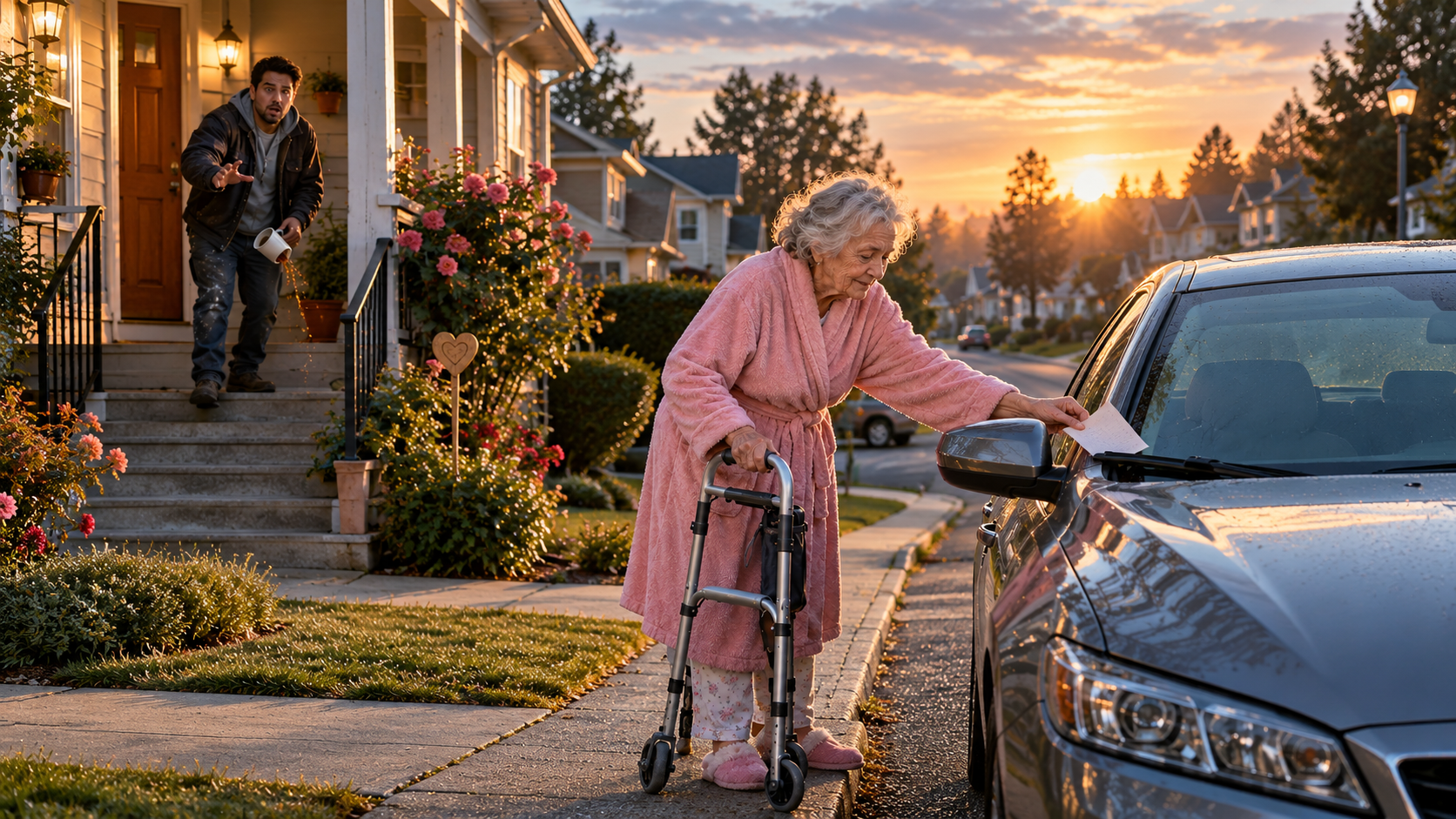
An elderly woman stepped out in a pink bathrobe and slippers, leaning on a walker. Very slowly — it took her almost four minutes — she crossed her lawn, crossed the edge of the street, and stopped beside Daniel’s car. She took a folded note from her pocket, lifted the windshield wiper with trembling fingers, and slipped it underneath.
Daniel’s coffee cup slipped out of his hand.
The woman turned at the noise. When she saw him, she did not look surprised. She just smiled.
“Well,” she said. “I suppose you caught me.”
Who she was
Her name was Margaret Ellison. She was 81 years old and had lived on Maple Street for fifty-two years.
Daniel walked her back to her porch and she invited him inside. On her kitchen table was a stack of small paper squares, a blue pen, and a pair of reading glasses.
“I don’t sleep much anymore,” she explained. “I sit by the window early in the morning. And I watched you leave every day, in the dark, with your shoulders all the way up to your ears. You looked like my son used to look.”
Her son, she told him, had died in a car accident thirty years earlier, on his way to an early shift. She had always wished someone had told him to slow down that morning.
“So I decided I would tell you,” she said.
Daniel asked her the question that had kept him awake. How did she know about his mother?
Margaret pointed to the window. In the spring, Daniel had planted a small rosebush by his front door, with a little wooden sign he had carved himself. He had forgotten it was even visible from the street.
The sign read: “For Mom. Always.”
“A man who plants roses for his mother,” Margaret said, “is a man whose mother would be proud.”
That was when Daniel sat down on her kitchen chair and cried for the first time in two years.
What happened next
Daniel still finds a note on his windshield every morning. But now there is also one waiting on Margaret’s door.
He leaves it on his way to work — usually something simple. “Drink some water today.” “I’ll bring groceries Saturday.” “Thank you for watching out for me.”
On Sundays he goes over for coffee. He fixed her porch railing, changed the batteries in her smoke detectors, and drives her to the doctor when her daughter can’t come from out of state.
“I moved to this street thinking I was completely alone,” Daniel says. “It turns out someone had been looking out for me every single day. I just never looked up.”
The shoebox in his closet is almost full now. He says he is going to need a bigger one.
Sometimes the people who care about us the most are the ones we have never thought to notice. Who in your life deserves a note today?
This story is a work of fiction inspired by real-life acts of kindness. Images are AI-generated illustrations.