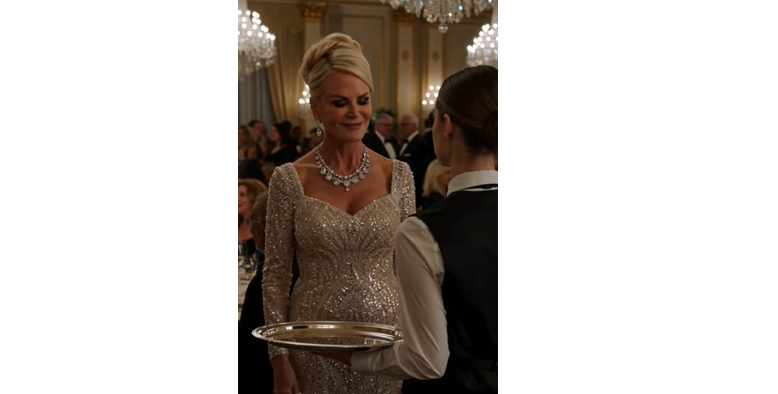
The annual Beaumont Foundation banquet was one of the most exclusive events in New York.
Crystal chandeliers illuminated the grand ballroom, while business leaders, wealthy donors, and local celebrities gathered around tables decorated with white orchids and polished silverware.
Among the guests was Veronica Hale, the elegant wife of a powerful real estate developer.
Veronica was known for her expensive clothes, her influential friends, and the way she treated anyone she considered beneath her.
That evening, a young waitress named Grace was assigned to serve her table.
Grace was twenty-four years old and had recently moved to the city from a small town. She spoke politely, worked carefully, and remained calm even when guests were demanding.
From the moment Veronica heard her accent, she began making comments.
“Try not to spill anything,” she said loudly. “I assume they do not teach proper service where you come from.”
Several guests looked uncomfortable.
Grace said nothing and continued working.
Later, Veronica deliberately dropped a used napkin beside her plate. When Grace approached with a tray, Veronica picked it up and threw it onto the tray.
“Take my trash, country girl!” she shouted.
The surrounding conversations stopped.
Veronica leaned back with a satisfied smile, certain the young woman would lower her head and walk away.
Instead, Grace calmly placed the tray on the table.
She looked directly into Veronica’s eyes.
“You have no right to speak to people like that.”
The entire ballroom fell silent.
Veronica’s smile disappeared for a moment, then returned sharper than before.
“How dare you speak to me that way?” she demanded, rising from her chair.
Grace did not move.
Veronica stepped closer.
“Do you have any idea who I am? I could have you dismissed before this evening is over.”
Grace remained composed.
Then she said one sentence.
“I know exactly who you are, Mrs. Hale—and I know whose signature you copied on those foundation documents.”
The color drained from Veronica’s face.
Her husband, Richard, slowly turned toward her.
“What is she talking about?”
Veronica forced a laugh.
“This girl is obviously confused.”
But Grace reached into the pocket of her apron and removed a sealed envelope.
She did not open it.
She simply placed it beside the tray.
The event director hurried over, but before he could speak, an elderly man at the neighboring table stood.
It was Samuel Beaumont, founder of the charity hosting the banquet.
“Let her finish,” he said.
Grace looked around the ballroom.
“My mother worked as an accountant for the Beaumont Foundation for eighteen years,” she explained. “Six months ago, she discovered that several large donations had been redirected into a private consulting company.”
Richard Hale stared at his wife.
Veronica’s expression hardened.
“This is ridiculous.”
Grace continued.
“The company was registered under another name, but the payments were approved using Samuel Beaumont’s signature.”
Samuel frowned.
“I never approved private consulting payments.”
Grace nodded.
“My mother knew that. She compared the signatures and found they had been copied from older documents.”
Veronica pointed at Grace.
“She is lying because she wants money.”
Grace’s voice remained steady.
“My mother did not want money. She wanted the foundation’s funds returned before children lost access to the programs those donations were meant to support.”
A murmur spread across the room.
The Beaumont Foundation funded shelters, school meals, and medical assistance for families in financial difficulty.
Samuel picked up the envelope.
“What is inside?”
“Copies of the altered records, payment confirmations, and emails discussing how the transfers would be hidden.”
Richard looked at Veronica again.
“You told me that consulting company belonged to an outside adviser.”
Veronica avoided his eyes.
Grace then revealed why she had taken a temporary job at the banquet.
Her mother, Helen, had tried to report the irregularities internally. Before she could meet Samuel, she was dismissed and accused of mishandling confidential files.
The accusation damaged her reputation and made it almost impossible for her to find another accounting job.
Grace believed someone might attempt to destroy the remaining evidence, so she had kept copies in a secure place.
When she learned Veronica would attend the banquet, she contacted Samuel’s attorney and arranged to deliver the documents publicly, where they could not quietly disappear.
Samuel’s attorney entered the ballroom accompanied by two members of the foundation’s independent audit committee.
He confirmed that Grace had contacted them several days earlier.
“The documents have already been copied and secured,” he said. “An external investigation began this afternoon.”
Veronica gripped the back of her chair.
“You cannot humiliate me like this in front of everyone.”
Grace looked at the dirty napkin still resting on the tray.
“I did not humiliate you, Mrs. Hale. I only refused to let you humiliate someone else while hiding what you had done.”
Richard stepped away from his wife.
He admitted that he had signed several business documents she placed before him but claimed he did not understand how the consulting company was being used.
Samuel ordered Veronica’s access to all foundation accounts suspended immediately.
The banquet continued, but the atmosphere had changed completely.
No one laughed at Grace’s accent again.
Over the next several weeks, investigators confirmed that Veronica had redirected a significant amount of charitable money through false consulting agreements.
Some of the funds had been used to support her private events and personal expenses.
The stolen money was recovered, and Veronica was removed from every position connected to the foundation.
Helen’s name was cleared.
Samuel personally apologized for failing to protect an employee who had tried to tell the truth.
He offered her the role of director of financial compliance, but Helen accepted only after the foundation agreed to create an independent reporting system for all employees.
Grace returned to college and completed her degree in nonprofit management.
Several years later, she joined the Beaumont Foundation—not as a waitress, but as the director of a program protecting workers who reported financial misconduct.
At her first public speech, she placed an ordinary white napkin on the podium.
The audience did not understand its meaning until she explained what had happened at the banquet.
“That night,” Grace said, “someone believed my uniform gave her permission to treat me without dignity.”
She paused.
“But dignity does not come from wealth, status, or the clothes we wear. It comes from knowing when to remain calm—and when silence would protect the wrong person.”