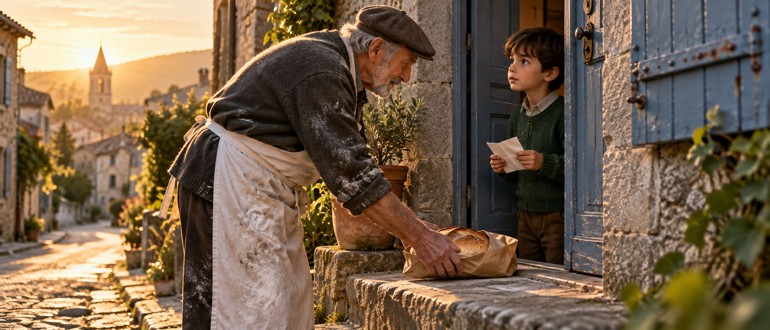
Every morning at five, before the village woke up, Étienne the baker walked down rue des Lilas with a warm loaf wrapped in paper. He placed it on the doorstep of number nine, a gray house with closed shutters, and left without a sound.
Everyone believed the house was empty. Its owner, Madame Odile, had been taken to a nursing home eleven years earlier. But Étienne had promised her something the day she left: “I will bring you your bread, as always.” He had never known how to break a promise.
So he kept going, in rain and in snow. The loaves piled up in his heart like unanswered letters. Sometimes he wondered if a stray cat ate them. He never checked.
One November morning, he arrived with the usual loaf and stopped. The doorstep was empty. No bread from the day before, no crumbs. Instead, under a stone, lay a folded sheet of paper.
His hands trembled as he opened it. The handwriting was uneven, a child’s handwriting. “Dear Mr. Baker, thank you for the bread. My little sister and I eat it every morning. Mom works at night and we are alone. Please don’t stop. Noah, age nine.”
Étienne sat down on the cold step. For eleven years he had fed a ghost, and all that time a house everyone believed empty had held two hungry children waiting for the smell of fresh bread.
Madame Odile’s grandson had moved into the house months earlier, a young mother with two children, working night shifts at the hospital. She had been too proud to ask for help. The village had walked past without noticing.
The next morning Étienne did not leave the loaf. He knocked. A small boy opened the door with serious eyes. “Are you the baker?” he asked. Étienne nodded, unable to speak.
“You came late today,” the boy said gently. “My sister was worried.” Étienne laughed and cried at the same time, and handed him not one loaf but a whole basket.
That evening he told everyone in the village. By the end of the week, the grocer sent vegetables, the neighbors brought blankets, and the doctor’s wife offered to look after the children during the night shifts.
The young mother came to the bakery to thank him. She could not find the words. Étienne only said, “It was never charity. It was a promise to your grandmother.”
Today the gray house has open shutters and flowers in the window. Every morning at five, Étienne still walks down rue des Lilas, but now he knocks, and two small faces open the door.
And on the doorstep, under a stone, there is always a note: “Thank you, Mr. Baker.”