Just moments earlier, laughter and whispers had filled the auditorium.
Now, no one was making a sound.
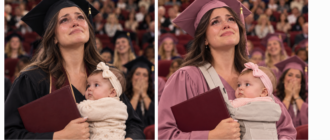
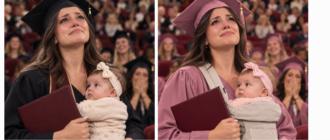
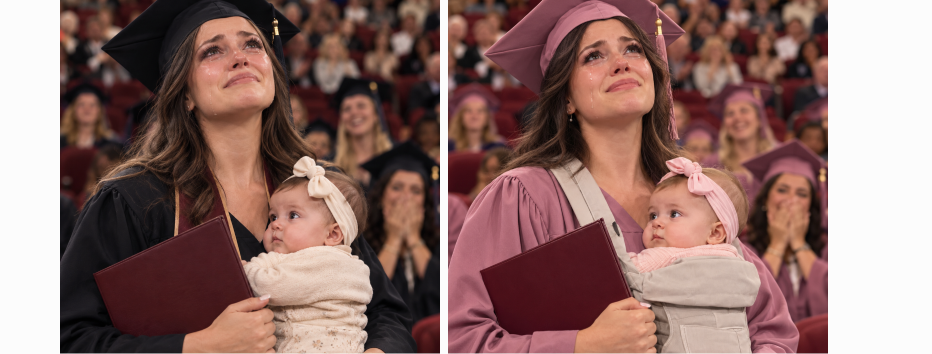
Emily Carter stood beneath the bright stage lights, dressed in her graduation gown, with a tiny baby resting against her chest. In one hand, she held the folder that was supposed to contain the diploma she had worked years to earn.
The other arm remained protectively around baby Liam.
Emily could feel hundreds of eyes watching her.
Some people were curious.
Some were confused.
And a few had been laughing only seconds earlier.
Emily had expected that.
What she had not expected was what Principal Richard said next.
“Before Emily Carter receives her diploma, this institution owes her a public apology.”
The room went completely still.
Emily slowly turned toward him.
For weeks, she had wondered whether she would even be allowed to attend this ceremony. A complaint had been filed against her shortly before graduation, raising questions about her final research project and temporarily putting her academic standing under review.
Her scholarship had also been placed on hold.
To many people, that had been enough.
They had already decided what kind of person Emily was before the investigation had even been completed.
Her aunt Diane had encouraged her to skip graduation altogether.
“You’ll only embarrass yourself,” she had told her.
But Emily came anyway.
And she brought Liam with her.
The baby had entered her life only weeks earlier.
Emily had spent much of her childhood knowing what it felt like to have adults discussing your future while you sat nearby, powerless to decide anything for yourself. After losing her parents when she was young, she had grown up carrying that memory.
It was one of the reasons she had chosen to study social work.
By the time she met Liam, Emily had already completed training connected to foster care and child welfare. When the newborn needed temporary care through the appropriate services, Emily began the official process required to help provide him with a safe home.
Some people admired her decision.
Others judged it.
But Emily refused to let their opinions decide what happened next.
Then came the complaint against her.
At first, it appeared to concern only her university work.
But while reviewing the records connected to her case, Emily began noticing details that did not seem to fit.
Dates appeared inconsistent.
Certain records contained unusual changes.
Information in one document did not always match information elsewhere.
Instead of making accusations, Emily carefully organized what she had found and submitted the material for proper review.
Then she waited.
Until graduation day, she still did not know what the university had concluded.
Principal Richard opened the folder in front of him.
“The review of Miss Carter’s academic work has been completed,” he announced.
Emily held Liam slightly tighter.
“The allegations concerning her research were not substantiated. Her work has been verified.”
A murmur moved through the audience.
Emily closed her eyes for a second.
That sentence alone felt as though a tremendous weight had been lifted from her shoulders.
But the principal continued.
“What began as a review of one student’s academic record also brought several unrelated administrative inconsistencies to our attention. Those matters are now being handled through the appropriate procedures.”
Several people in the audience suddenly stopped smiling.
Emily glanced toward Diane.
Her aunt was staring straight ahead.
Beside her, another relative lowered her eyes.
Principal Richard did not name anyone.
He simply closed the folder and looked directly at Emily.
“Your graduation should never have been overshadowed by claims that had not yet been established. On behalf of this institution, I apologize.”
For a moment, Emily could not respond.
Then someone in the back of the auditorium began applauding.
Another person joined.
Within seconds, the room filled with applause.
Emily’s eyes filled with tears.
She looked down at Liam.
The baby was completely unaware of the drama surrounding him. His tiny fingers had wrapped themselves around a piece of her graduation gown.
Emily smiled through her tears.
She thought the moment was over.
It wasn’t.
Principal Richard raised his hand again.
“There is one more announcement.”
The applause slowly faded.
Emily looked back at him.
The principal explained that the university foundation had also reviewed the suspension of Emily’s financial support.
“The funding that was placed under review has been fully restored.”
Emily covered her mouth.
But he continued.
“A donor who learned about Emily’s academic work and her commitment to helping vulnerable children has also established additional educational support for students pursuing work in child and family services.”
He paused.
“And Emily Carter will be its first recipient.”
This time, Emily could no longer hold back her tears.
She had walked onto that stage expecting to collect a diploma and quietly leave.
Instead, the institution had publicly cleared her name.
Principal Richard handed her the diploma.
“Congratulations, Emily.”
“Thank you,” she whispered.
Then she turned toward the audience.
Her eyes briefly met Diane’s.
For years, Emily had imagined what she might say if she ever had the opportunity to answer every cruel remark and every judgment made about her.
But standing there, she realized she did not need a dramatic confrontation.
She did not need to humiliate anyone.
The truth had already spoken for her.
Emily simply turned and began walking across the stage.
Liam remained against her chest.
As she reached the other side, his tiny hand suddenly closed around her finger.
Emily stopped and looked down.
Then she laughed through her tears.
The audience applauded again.
This time, she heard no whispers.
No laughter.
No judgment.
Only applause.
Six Years Later
Emily returned to the same university.
But she was no longer wearing a graduation gown.
She stood behind a podium as a guest speaker.
After continuing her education, Emily had built a career helping children and families navigating difficult transitions. She had also become involved with programs designed to support young people leaving foster care as they pursued education, housing, and employment.
Sitting near the front of the auditorium was a little boy.
Liam.
He was no longer the tiny baby Emily had carried across the graduation stage.
When he noticed her looking at him, he waved enthusiastically.
Emily smiled.
Behind her, a large screen displayed an old photograph from graduation day.
A young woman in a cap and gown.
A diploma in her hand.
A baby against her chest.
Emily looked at the photograph for several seconds.
Then she addressed the students.
“Sometimes people will decide who you are before they have heard your story.”
The auditorium became quiet.
“You cannot always control what people say about you. You cannot always stop someone from misunderstanding you. But you can decide what you do next.”
Her eyes moved toward Liam.
“And sometimes the moment that feels like everything is falling apart becomes the beginning of a life you never expected.”
After the speech, Liam ran toward her.
“Were you scared that day?” he asked.
Emily smiled.
“Very scared.”
“Then why did you still go onstage?”
Emily crouched so they were at eye level.
“Because being afraid doesn’t always mean you should turn around.”
Liam thought about that.
Then he pointed toward the old photograph.
“You really carried me across the stage?”
“I really did.”
“Was I heavy?”
Emily laughed.
“Extremely heavy.”
Liam grinned and wrapped his arms around her.
Emily hugged him tightly.
For years, she had thought graduation day would be remembered as the day she finally proved everyone wrong.
But eventually she understood that it meant something much bigger.
It was the day she stopped allowing other people’s judgment to determine how she saw herself.
And the baby she had once carried across that stage had become part of the family and future she had fought so hard to build.
Sometimes the person being judged most quickly is carrying a story no one has taken the time to hear.