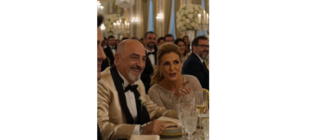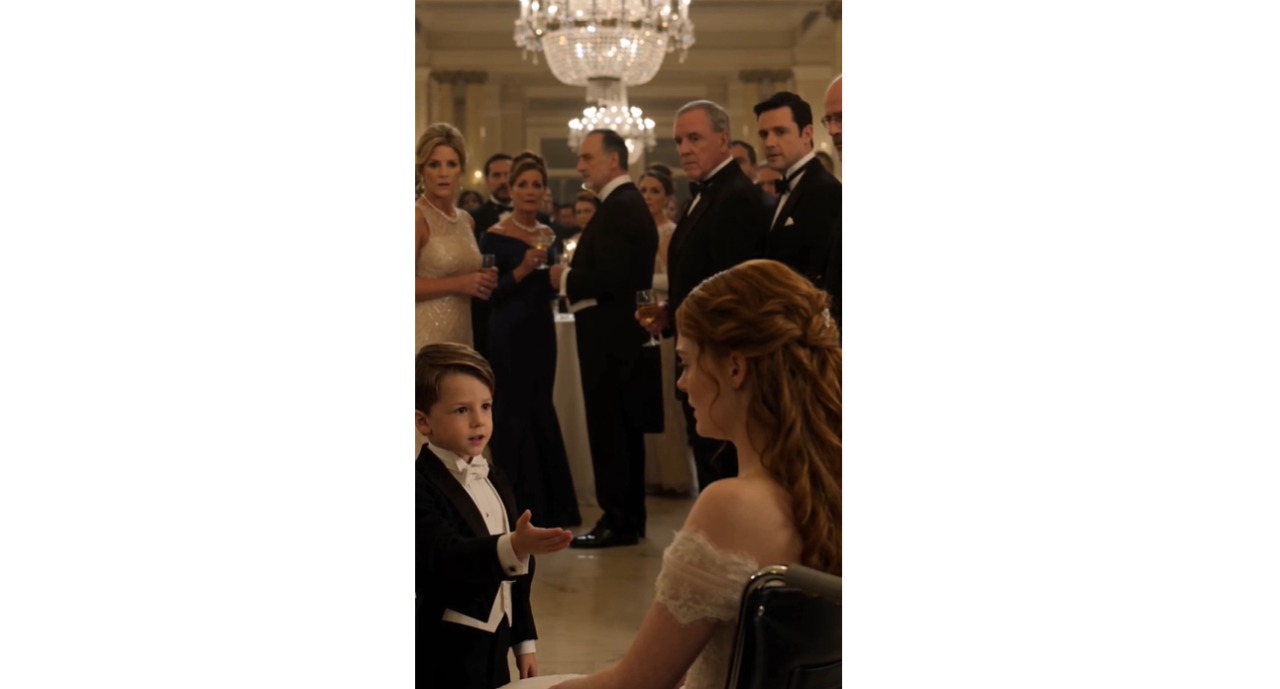
The ballroom glittered beneath enormous crystal chandeliers.
Hundreds of guests in elegant gowns and dark suits filled the hall, speaking softly as waiters moved between tables carrying glasses of sparkling water and trays of desserts.
At the center of the room, musicians’ instruments rested unused on a raised platform. The charity gala had paused between speeches, leaving only the quiet movement of chairs, footsteps and murmured conversations.
Near the edge of the dance floor sat a woman named Evelyn Hart.
She was forty-two years old and had used a wheelchair for nearly six years.
Once, Evelyn had been a professional dancer.
She had performed on some of the most famous stages in Europe and had spent most of her life believing that movement was the purest form of freedom.
Then a serious car accident changed everything.
Her injuries were severe.
After several operations and years of rehabilitation, doctors told her that although some feeling remained in her legs, the damage made independent walking extremely unlikely.
Evelyn tried to remain hopeful at first.
She followed every treatment plan.
She attended physical therapy daily.
She learned to balance between support bars and practiced shifting her weight from one foot to the other.
But progress came slowly.
Each failed attempt left her more exhausted and frightened.
Eventually, she stopped trying to stand.
She told everyone that she had accepted her new life.
The truth was more complicated.
She had not accepted it.
She had simply become terrified of falling again.
That evening, Evelyn had attended the gala because the event was raising money for children without stable housing.
Her older brother, Thomas, was one of the organizers.
He hoped the evening might help her reconnect with the world she had gradually avoided.
Evelyn had agreed to come, but she remained close to the wall, watching other people move across the ballroom.
Every turn, every step and every graceful gesture reminded her of the life she had lost.
Then a barefoot little boy appeared at the entrance.
He looked no older than eight.
His trousers were slightly too large, and the sleeves of his white shirt had been folded several times.
He moved through the elegant crowd without hesitation.
Some guests stared at his bare feet.
Others assumed he belonged to one of the performers or catering workers.
The boy ignored them all.
He walked directly toward Evelyn.
When he reached her wheelchair, he held out his hand.
“Dance with me,” he said softly. “You won’t need this chair.”
The entire ballroom fell silent.
Evelyn stared at him.
For a moment, she thought she had misheard.
Then she looked at his small hand still waiting in front of her.
Tears gathered in her eyes.
“I haven’t walked in years,” she whispered.
The boy remained calm.
“You just forgot how to stand.”
A few guests exchanged uncomfortable looks.
Thomas began walking toward them, afraid the child’s words might hurt his sister.
But Evelyn raised one hand, asking him to stop.
There was something familiar in the boy’s expression.
He did not look amused.
He did not seem to be challenging her.
He looked at her with complete certainty.
“What is your name?” Evelyn asked.
“Samuel.”
“Where are your parents?”
Samuel glanced toward the far end of the ballroom.
A woman wearing a simple black dress stood near the service entrance.
Her name was Maria.
She worked at a nearby shelter for families experiencing homelessness and had brought several children to the gala as invited guests.
Samuel had arrived wearing borrowed shoes.
They had been too small and painful, so Maria had allowed him to remove them.
Evelyn looked back at the boy.
“Samuel, I may fall.”
“I’ll still hold your hand,” he replied.
The simplicity of the answer broke through something inside her.
For years, every person around Evelyn had treated standing as a medical test.
Therapists counted seconds.
Doctors measured strength.
Family members watched with fear.
Samuel treated it as something much simpler.
A person wanted to dance.
Another person was offering a hand.
Evelyn slowly placed her fingers in his.
His hand was warm.
She moved closer to the edge of the wheelchair.
Her breathing became shallow.
Thomas stood nearby, ready to help.
Samuel looked at him and said:
“Don’t lift her. She has to remember.”
Evelyn placed both feet flat on the floor.
Her legs immediately began to tremble.
She tightened her grip on the armrest.
The wheelchair creaked softly behind her.
Every guest in the ballroom seemed to stop breathing.
Evelyn leaned forward.
For one frightening second, nothing happened.
Then she felt pressure beneath her feet.
Her muscles responded weakly, but they responded.
She pushed upward.
Her body rose several inches from the seat.
A gasp passed through the room.
Pain shot through her legs.
Fear told her to sit down immediately.
Samuel squeezed her hand.
“Look at me,” he said.
Evelyn lifted her eyes.
The boy smiled.
“Not at the floor.”
She tried again.
This time, Thomas moved closer but kept his hands away.
Evelyn pushed against the armrest and raised herself farther.
Her knees shook violently.
She was halfway up when her strength failed.
She dropped back into the chair.
Several guests rushed forward.
Evelyn lifted her hand.
“No.”
Her voice was unsteady, but firm.
“I want to try again.”
She had not said those words in almost three years.
Samuel remained beside her.
“Good,” he said. “Now you remember the beginning.”
Evelyn laughed through her tears.
She repositioned her feet.
On the second attempt, she rose higher.
Thomas stood behind her without touching her, prepared to catch her if necessary.
Evelyn straightened slowly until she was standing between the chair and the boy.
The ballroom erupted in applause.
But Evelyn barely heard it.
She was standing.
Not securely.
Not independently.
But for the first time in years, she was looking at the room from her full height.
Samuel took one small step backward.
Evelyn’s face filled with panic.
“Don’t let go.”
“I won’t,” he said. “Take one step.”
“I can’t.”
“You already did the hardest part.”
Evelyn shifted her weight.
Her right foot moved only a few centimeters.
It was barely a step.
But it was movement.
Samuel moved with her.
Then she moved her left foot.
The guests fell silent again.
Evelyn took three small, trembling steps before Thomas gently brought the wheelchair behind her.
She sat down, crying openly.
People surrounded her, congratulating her and calling the moment a miracle.
But Evelyn knew it was not a miracle.
Her condition had never made movement completely impossible.
Her doctors had always said that limited supported standing might one day be achievable.
The greater obstacle had become fear.
Samuel had not healed her legs.
He had interrupted the belief that she should never try again.
Evelyn turned toward him.
“How did you know I could stand?”
Samuel looked surprised by the question.
“My mother stopped walking too.”
The room became quiet.
Maria approached and placed a hand on Samuel’s shoulder.
She explained that his mother had suffered a serious injury when Samuel was very young.
She used a wheelchair during rehabilitation and repeatedly refused to attempt standing because she feared another fall.
Samuel had watched his grandmother encourage her every day.
She often told her:
“You haven’t lost everything. Sometimes your body remembers after your courage does.”
Samuel’s mother eventually learned to walk short distances with support.
But she died two years later from an unrelated illness.
Before her death, she had told Samuel never to be afraid of offering hope, even when adults had forgotten how to accept it.
Evelyn listened with tears in her eyes.
“You said the same words to your mother?”
Samuel nodded.
“She told me I helped her remember.”
Evelyn took his hand again.
“You helped me remember too.”
After the gala, Evelyn contacted her rehabilitation specialist.
The doctor warned her not to expect immediate recovery.
Standing once during an emotional moment did not mean she could safely walk alone.
Her muscles were weak, her balance remained limited and the risk of injury was real.
Evelyn understood.
For the first time, she did not demand a promise that she would fully recover.
She asked only for the opportunity to begin again.
Therapy was difficult.
Some days she stood for ten seconds.
Other days she could not rise at all.
There were falls, setbacks and weeks when progress seemed invisible.
Samuel visited her regularly with Maria.
He never asked how far she had walked.
He asked a different question.
“Did you try today?”
Six months later, Evelyn could stand using a walking frame.
Three months after that, she could take several supported steps.
She continued using her wheelchair for long distances, and her doctors explained that she might always need it.
Evelyn no longer viewed that as failure.
The chair gave her independence.
Standing gave her another choice.
A year after the gala, the charity held its annual event in the same ballroom.
Evelyn attended again.
This time, she arrived in her wheelchair with a pair of lightweight support braces beneath her dress.
Samuel, now wearing shoes that fit properly, waited near the dance floor.
When he saw her, he smiled and held out his hand exactly as he had the year before.
“Dance with me.”
Evelyn locked the wheelchair brakes.
With Samuel on one side and Thomas nearby, she slowly stood.
The guests watched in silence.
She took one step.
Then another.
There was no dramatic performance.
No perfect turn.
No effortless recovery.
Evelyn and Samuel simply moved together across a small section of the ballroom while everyone watched.
For less than one minute, Evelyn danced again.
When she returned to her chair, the room filled with applause.
She leaned toward Samuel.
“You were wrong about one thing,” she said.
He looked worried.
“What?”
“I didn’t forget how to stand.”
She smiled.
“I forgot that falling didn’t mean I had to stop trying.”
Later that evening, Evelyn announced the creation of a new rehabilitation program funded by her family’s foundation.
It would provide physical therapy, mobility equipment and emotional support for people who could not afford long-term treatment.
The program was named the Samuel Project.
Years later, Evelyn still used her wheelchair.
She could stand and walk short distances with support, but she never returned to the life she had before the accident.
Instead, she built a different one.
She taught movement classes for people with disabilities, helped design accessible dance programs and became an advocate for realistic rehabilitation without shame or false promises.
Samuel remained part of her family.
The barefoot boy had not performed a miracle in the ballroom.
He had done something quieter and, in its own way, just as powerful.
He had looked at a woman whom everyone saw as fragile and treated her as someone still capable of beginning again.