The afternoon in the park felt peaceful at first.
Children’s laughter floated from the swings in the distance. Birds moved between the trees. A soft breeze stirred the leaves above the walking path, and the sunlight filtered gently through the branches.
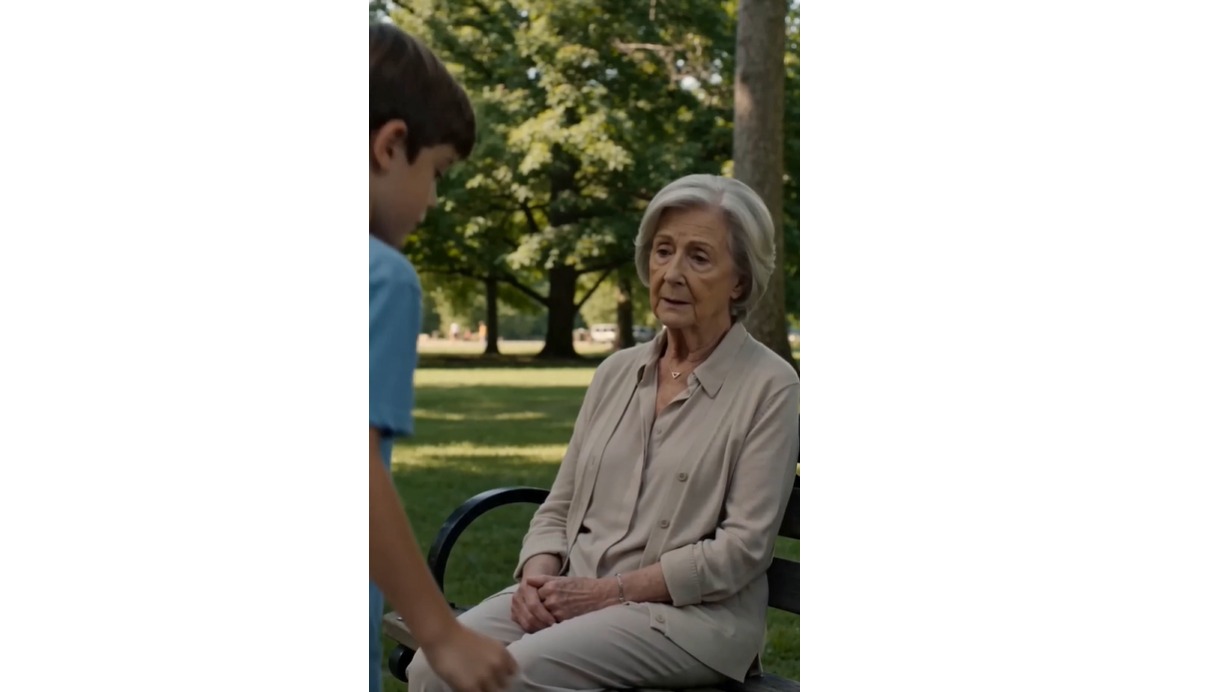
On an old wooden bench near the path sat an elderly woman named Helen.
She came to that park almost every afternoon.
Sometimes she brought breadcrumbs for the birds. Sometimes a small book. Sometimes she simply sat and watched the world move around her. The bench she sat on was old, worn by time and weather, but she liked it anyway. It had become part of her routine, something familiar in a world that changed too fast.
That afternoon, a young mother arrived with her little son.
The boy looked about six years old—full of energy, loud, restless, and eager to turn everything around him into a game. He ran ahead of his mother, circling the bench once before suddenly lifting his foot and kicking one of its wooden legs.
A sharp little thud broke the calm.
Helen looked at him.
The boy kicked the bench again.
This time the wood gave a faint creak.
Helen’s expression stayed gentle.
She leaned slightly forward and said kindly:
“Sweetheart, please don’t do that. It might break.”
The boy looked at her for half a second.
Then, almost as if testing the warning, he kicked the bench again.
His mother had been watching the whole thing.
Instead of correcting him, she gave a light laugh.
“My son is just brave,” she said with a smile. “Let him play.”
Helen fell silent.
She didn’t argue.
She didn’t scold the boy.
She simply folded her hands in her lap and looked ahead, as if she had said all she needed to say.
The mother seemed satisfied with herself, almost proud.
To her, her son’s behavior looked like confidence.
A child with spirit.
A boy who wasn’t afraid of anything.
The little boy lifted his foot one more time and kicked the bench harder.
This time, the old wood responded with a loud crack.
One of the side pieces loosened with a rough splintering sound.
The boy jumped back, startled.
He was safe.
Nothing hit him.
But for the first time, the playful energy vanished from his face.
The mother gasped and rushed forward.
“Oh my God!”
Then her face changed immediately from shock to irritation.
“Why is this bench in such bad condition?” she said angrily, as if the bench itself had caused the problem.
A few nearby people turned their heads.
The laughter from farther away seemed suddenly more distant.
Helen placed both hands on the bench and slowly rose to her feet.
She wasn’t angry.
She wasn’t loud.
That calmness made what happened next even more powerful.
She looked directly at the mother and said:
“Sometimes children don’t need more courage. They need someone to teach them respect.”
The mother froze.
The words landed harder than any argument would have.
For a moment she had no reply.
Her son stood beside her, quiet now, staring at the loosened piece of wood near the bench leg as if he were trying to understand exactly what had changed.
Helen gently brushed her skirt flat with one hand.
She looked at the boy, not unkindly.
Then back at the mother.
“I wasn’t worried about the bench,” she added softly. “I was worried about what he was learning.”
The mother opened her mouth, then closed it again.
There was no easy way to defend what had happened.
A minute earlier, she had laughed at the warning.
Now the lesson stood in front of her in plain sight.
Not in the broken wood.
In her son’s face.
The little boy tugged lightly at his mother’s hand.
“Mom…”
His voice was quieter now.
Not rebellious.
Not proud.
Just uncertain.
The mother looked down at him, and for the first time there was no amusement left in her expression.
Only discomfort.
And maybe a little shame.
Helen slowly stepped away from the bench.
She could have walked off then, leaving the silence behind her.
But something in the mother’s face—some sign that the moment had reached her—made Helen pause.
“When children are small,” she said, “people often call everything cute. The shouting. The disrespect. The refusal to listen. They call it confidence. They call it personality. They call it spirit.”
The mother kept listening.
Helen continued:
“But if no one teaches them the difference between courage and carelessness, one day the world will teach it much more harshly.”
The mother lowered her eyes.
Her son looked from the broken bench to the old woman, then back to his mother.
He seemed to understand, at least in the way children sometimes do—not through long explanations, but through the sudden weight in the air around grown-ups.
“I didn’t mean to break it,” he said quietly.
Helen gave him a small nod.
“I know,” she said. “That’s why this was the right moment to learn.”
The mother let out a slow breath.
At last she said, almost reluctantly:
“You’re right.”
It wasn’t loud.
It wasn’t graceful.
But it was honest.
Helen nodded once.
The mother knelt slightly beside her son and put a hand on his shoulder.
“What do you say?” she asked softly.
The boy looked at Helen.
“I’m sorry.”
Helen smiled for the first time.
“Thank you,” she said. “That matters.”
The mother looked at the broken bench and then back at Helen.
“I should have stopped him.”
Helen didn’t rush to comfort her.
“That’s your job,” she said gently. “Not because he’s a bad child. Because he’s still learning who to become.”
The mother swallowed hard.
Something about the sentence stayed with her.
It didn’t feel like criticism anymore.
It felt like truth.
A truth she had not wanted to hear—but needed to.
The little boy moved closer to his mother and stopped kicking at the ground.
The restless confidence that had filled him a minute earlier had turned into something quieter. Thoughtful, maybe. Embarrassed, maybe. But also more aware.
The park itself seemed to settle around them.
Children still played in the distance.
Birds still moved in the trees.
The bench still stood there, slightly damaged but not destroyed, as if even it had become part of the lesson.
A park worker eventually walked over after noticing the loose wood.
The mother immediately apologized and offered to pay for the repair.
The worker waved it off for the moment and said he would report it.
Helen began gathering her things.
Before leaving, she looked once more at the boy.
“Being strong,” she said, “is not about what you can kick or break.”
The boy listened carefully.
“It’s about what you know how to protect.”
He nodded.
This time, he really seemed to hear her.
As Helen walked away down the path, the mother remained beside her son in silence.
Later that evening, when they got home, she would think again about that sentence.
Not about courage.
Not about the bench.
About respect.
And about how easily adults sometimes mistake a lack of boundaries for confidence, simply because correcting a child feels uncomfortable in the moment.
But real love was not letting a child do whatever he wanted.
Real love was teaching him how to exist in the world without damaging everything around him.
The next week, the mother returned to the same park with her son.
They brought a small bag of birdseed and stopped by the same bench, now repaired.
Helen was there again.
The boy walked up first.
This time he didn’t kick the bench.
He gently touched the wooden slat and then looked at Helen.
“I remember,” he said.
Helen smiled.
“I can see that.”
The mother stood nearby, quieter than before, but with a different kind of confidence now—the kind that comes not from pretending your child is always right, but from choosing to guide them even when it’s uncomfortable.
The boy sat carefully beside Helen for a minute and asked if he could help feed the birds.
She handed him a few crumbs.
And together, without another lecture, they watched the birds gather near the grass.
Because sometimes the strongest lessons don’t come from shouting.
They come from a crack in old wood, a moment of silence, and one calm sentence spoken at exactly the right time.