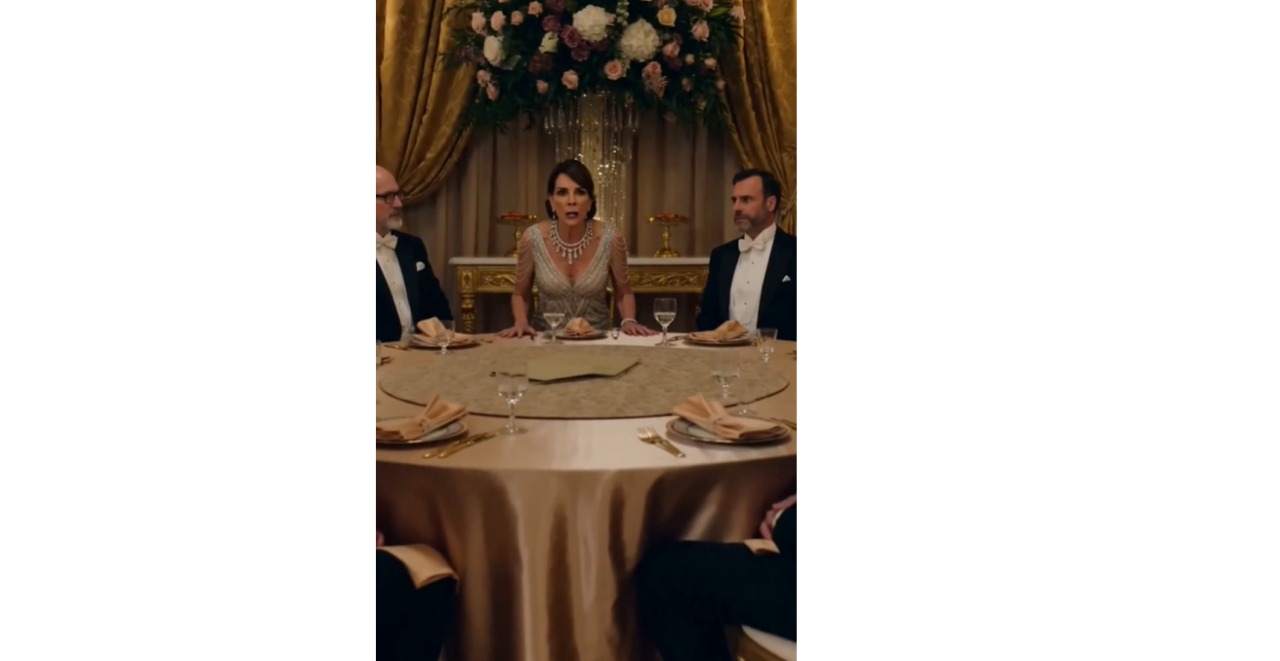
The wedding reception was supposed to be perfect.
The ballroom shimmered with crystal chandeliers, white roses, gold candlelight, and the low sound of wealthy guests praising the décor, the champagne, and the power of the Whitmore family.
At the center of it all stood Daniel Whitmore and his new bride, Emily.
They had just finished the first dance.
The band had gone quiet.
Glasses were raised.
Every eye in the room was fixed on the family table, where Daniel’s mother, Margaret Whitmore, sat like a queen who believed the entire evening existed for her approval.
Margaret had planned everything.
The guest list.
The press coverage.
The seating chart.
Even the exact moment when she would stand up and give the speech that reminded everyone who truly controlled the Whitmore name.
But before she rose for her speech, her eyes landed on someone at the edge of the family section.
An elderly woman.
She was dressed plainly in a dark, old-fashioned dress and a worn coat, and she sat quietly with an old handbag resting on her lap.
She had not touched the champagne.
She had not spoken to anyone.
She had simply been there, calm and silent, while everyone else glittered around her.
Margaret’s expression changed instantly.
First irritation.
Then anger.
Then something closer to panic.
She stood so abruptly that her chair scraped loudly across the polished floor.
The room slowly fell silent.
Guests turned toward her.
Margaret forced a smile, but her voice came out sharp and cold as she pointed directly at the elderly woman.
“I’m sorry,” she said loudly, “but I think everyone here is wondering the same thing. Why are you still sitting there?”
The room froze.
The elderly woman looked up, but said nothing.
Margaret stepped closer.
“This is a private family reception,” she continued. “Some people should know when they are no longer welcome.”
A few guests exchanged uncomfortable glances.
Others whispered.
The bride, Emily, looked confused.
Daniel frowned.
“Mom—” he started quietly.
But Margaret lifted a hand, silencing him.
Then she looked back at the elderly woman and said the words that made the room tighten:
“You should have left before anyone noticed you.”
The woman still did not answer.
She only held her old handbag a little tighter.
The whispers grew louder.
People expected tears.
Humiliation.
A trembling apology.
A slow walk to the door.
Instead, the elderly woman slowly stood.
Not in fear.
Not in shame.
But with a calm dignity that made the room even quieter.
She opened her handbag carefully and took out an old document folder, its corners worn from time.
Then she placed it on the table in front of Margaret.
Margaret’s face changed at once.
The color drained from it so quickly that even the guests furthest away noticed.
The elderly woman opened the first document and looked directly at Margaret.
Then, in a calm and steady voice, she said:
“You were right about one thing. I should not have been sitting quietly.”
No one moved.
No one breathed.
She opened another paper.
Then another.
On the final page, under the light of the ballroom chandeliers, an official court seal shone clearly.
Margaret took one step back.
Daniel stared at the paper.
Emily looked from one face to another, no longer understanding what kind of wedding she had just married into.
The elderly woman lifted her eyes and said:
“My name is Rose Bennett. For thirty-two years, I served as executive secretary to your late father-in-law, Arthur Whitmore.”
That name moved through the room like a current.
Arthur Whitmore had been the real empire behind the family fortune.
The founder.
The strategist.
The man whose portrait still hung in the family office downtown.
He had died seven years earlier, and since then Margaret had spoken as if his power had simply become hers.
Rose continued:
“And these papers prove that before his death, Arthur Whitmore made me the court-appointed executor and legal trustee of the Whitmore family holdings until Daniel’s wedding day.”
The ballroom fell into complete silence.
Daniel’s face went pale.
“What?” he whispered.
Margaret spoke immediately, too quickly.
“That’s absurd.”
But her voice was no longer strong.
It shook.
Rose turned one page toward Daniel.
“You were never shown the full trust papers,” she said softly. “Your grandfather amended them in secret six months before he died.”
Daniel stepped forward.
His hands trembled as he picked up the document.
The official seal was real.
The signature was real.
And beneath it was Arthur Whitmore’s own handwritten statement.
Daniel read only a few lines before his expression changed.
Emily looked at him in alarm.
“What does it say?”
Daniel swallowed hard.
Then he read aloud:
‘If this letter is being opened on my grandson Daniel’s wedding day, then the trust has reached its final condition. Control of all Whitmore holdings transfers directly to Daniel Whitmore, and all temporary authority granted to Margaret Whitmore is terminated immediately.’
A gasp passed through the room.
Margaret opened her mouth.
“Daniel, listen to me—”
But Rose calmly lifted another page.
“There is more.”
She turned the document toward the guests at the nearest table.
“This is the supporting affidavit. Arthur Whitmore requested legal protection because he had reason to believe family funds were being quietly redirected without authorization.”
Margaret’s hands started to shake.
“Stop this,” she said, almost in a whisper.
But Rose did not stop.
She opened the last sheet in the folder.
Attached to it were copies of old wire records and legal notices.
“Your father-in-law discovered that money from the Whitmore Foundation had been used to cover private debts, luxury purchases, and unauthorized transfers.”
Every word seemed to strike Margaret like a blow.
Daniel looked at his mother as if he no longer recognized her.
“You used foundation money?”
Margaret’s eyes flashed.
“I protected this family!”
“You stole from it,” Daniel said.
The words came out low, but the silence in the ballroom made them thunder.
Emily stepped back from the family table.
Her bouquet ribbon brushed against the side of her dress as she stared at Margaret in disbelief.
Rose kept her voice calm.
“Arthur did not want scandal while he was alive. He believed Daniel was too young then to carry this burden. So he created a sealed arrangement: Margaret could remain in visible control only until Daniel’s wedding day. After that, the truth—and the authority—would pass to him.”
Daniel lowered himself slowly into a chair.
For a moment he looked less like a groom and more like a son realizing his entire family history had been staged around him.
Margaret tried again.
“Daniel, your grandfather was old. He misunderstood things. Rose was only staff. She filled his head—”
“That’s enough,” Rose said quietly.
It was the first time her voice had sharpened.
And somehow it carried more power than Margaret’s shouting ever had.
Rose looked directly at her.
“You called me ‘only staff’ for thirty years. But when Arthur Whitmore needed someone honest enough to protect his grandson, he did not choose his relatives. He chose me.”
Nobody in the room could look away.
The old handbag on the table no longer looked small.
The woman beside it no longer looked invisible.
She looked immovable.
Daniel slowly lifted the final letter from the folder.
There was another note clipped behind it.
A personal one.
He opened it with trembling fingers.
The handwriting was clearly his grandfather’s.
He read it silently at first.
Then his eyes filled.
Emily moved closer to him.
“What is it?”
Daniel looked up, his voice breaking.
“He wrote… ‘Do not mistake loudness for loyalty. The people who truly protect you are often the ones expected to remain silent.’”
Rose lowered her eyes for a moment.
Margaret took another shaky step backward.
The guests now stared at her the way they had once stared at Rose.
Not with pity.
With shock.
And with judgment.
One of the older men from the Whitmore board stood from his table.
“Mrs. Whitmore,” he said carefully, “if these records are authentic, the board will have no choice but to freeze all discretionary family accounts until a full review is completed.”
Margaret turned to him in disbelief.
“You can’t be serious.”
But even as she said it, she knew.
The ground had already disappeared beneath her.
Another board member nodded.
“We have no choice.”
Emily looked at Daniel.
“Did you know any of this?”
He shook his head slowly.
“No.”
Then he turned to Rose.
“Why didn’t you tell me sooner?”
Rose’s face softened for the first time.
“Because your grandfather asked me not to. He said the truth would come to you on the day your life began on your own terms. He wanted you to enter marriage as a man, not as a son still trapped in your mother’s shadow.”
Those words seemed to settle over the entire room.
Margaret looked around desperately, as if searching for someone who would still stand beside her.
But no one moved.
The same guests who had expected an old woman to cry and leave were now silently watching the collapse of the most powerful woman in the room.
Daniel stood.
He turned to his mother.
For a long moment, he said nothing.
Then, finally:
“All these years… you made me believe everything in this family was built on tradition and honor.”
Margaret’s lips trembled.
“I did what I had to do.”
Daniel’s expression hardened.
“No. You did what you wanted to do.”
Then he looked at the folder on the table, at the seal, at the old handbag, at Rose.
And for the first time that evening, he smiled sadly.
Not from happiness.
From recognition.
He understood now who had really been protecting him all along.
He walked toward Rose and gently placed his hand over hers.
“You came here alone?”
Rose gave a faint smile.
“I have been alone in harder rooms than this one.”
Daniel nodded.
Then he did something no one expected.
He turned toward the entire ballroom and said clearly:
“This wedding reception will continue. But from this moment on, Rose Bennett does not sit in the back of any room connected to my family again.”
A murmur moved through the hall.
Daniel pulled out the chair beside him at the family table.
“My grandfather trusted her more than anyone. So from now on, so do I.”
Rose hesitated.
Daniel spoke softly.
“Please. Sit with us.”
For the first time all night, the guests saw emotion break through the old woman’s calm.
Not pride.
Not triumph.
Just quiet relief.
She sat.
Emily took Rose’s hand warmly.
And across the room, Margaret stood alone.
No one rushed to comfort her.
No one defended her.
Because everyone had seen the seal.
Everyone had heard Arthur Whitmore’s words.
And everyone now understood that the woman they had dismissed was never a helpless guest.
She was the keeper of the truth.
In the weeks that followed, the story shook the Whitmore family completely.
The board froze several accounts.
A private investigation confirmed the unauthorized transfers.
Margaret quietly stepped down from every foundation position she held.
Some newspapers heard rumors, but the family kept most of the details out of public headlines.
Still, in wealthy circles, everyone talked.
They talked about the mother who tried to humiliate an elderly woman at her own son’s wedding.
They talked about the old handbag.
The sealed folder.
The official documents.
And the moment the most powerful woman in the hall realized the quietest person in the room had the power to end everything.
A month later, Daniel and Emily held a much smaller dinner at their home.
No press.
No social theater.
No performance.
Just the people they trusted.
At the head of the table sat Daniel.
At his right sat Emily.
And at his left sat Rose Bennett.
During dessert, Daniel raised his glass and said:
“My grandfather built the company. But one woman protected his word when nobody else would.”
Then he looked at Rose.
“You were never ‘just staff.’ You were family long before the rest of us earned the right to use that word.”
Rose’s eyes filled, though she quickly looked down.
And for the first time in many years, she allowed herself not just to protect the Whitmore future—
but to belong inside it.
That was the truth the ballroom learned that night.
Not every important woman arrives in diamonds.
Sometimes she comes with an old handbag, a sealed folder, and the courage to stop sitting quietly.