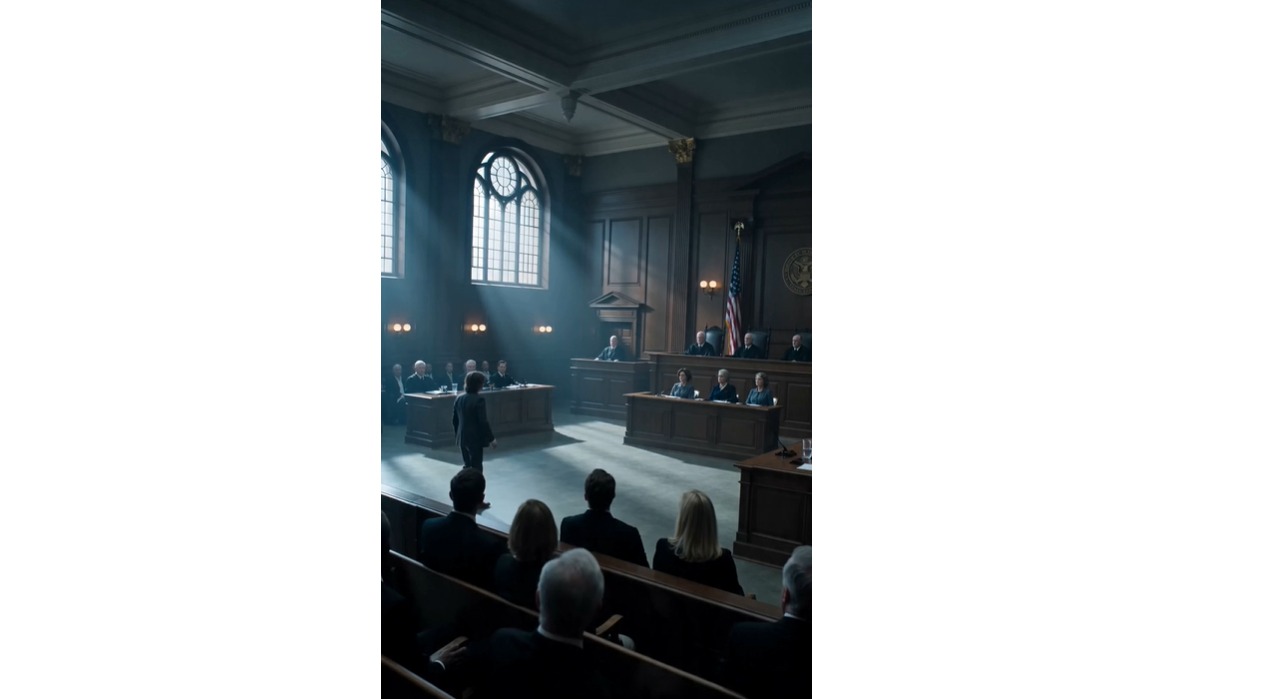
The courtroom was silent except for the faint sound of papers moving across the judge’s desk.
Clara sat at the defense table with her hands folded tightly in her lap.
She had worked for the Harrington family for seven years.
She had cleaned their mansion, prepared their guest rooms, cared for their youngest son when he was sick, and stayed late on nights when no one thanked her.
But now she sat in court accused of stealing a diamond brooch worth more than she had earned in years.
Across the room sat the Harrington family.
Edward Harrington, a millionaire businessman, looked tense and exhausted. Beside him sat his mother, Margaret Harrington, perfectly dressed in dark silk, her back straight, her expression cold.
She had been the first to accuse Clara.
She had told everyone the same story.
The diamond brooch disappeared after a family dinner.
Clara had been the last employee inside the room.
Therefore, Clara had taken it.
Clara had denied it from the beginning.
But no one believed a housekeeper over a woman like Margaret Harrington.
The hearing was already going badly.
The family’s lawyer stood and said firmly:
“The missing brooch was kept in Mrs. Harrington’s private jewelry cabinet. Only household staff had access to the room that evening.”
Clara lowered her eyes.
Her lawyer tried to object, but the damage was already done.
People in the courtroom looked at her with suspicion.
As if poverty itself were proof.
Margaret Harrington sat still, her face unreadable.
Then, suddenly, the courtroom door opened.
A young boy ran inside.
“Clara is innocent!”
Everyone turned.
It was Noah Harrington, Edward’s ten-year-old son.
His hair was messy, his breathing was fast, and in his trembling hands he held a small velvet box.
Edward stood up immediately.
“Noah? What are you doing here?”
But the boy didn’t look at him.
He looked at Clara.
Clara sat frozen, unable to understand what was happening.
Noah stepped forward, holding the box tightly.
“I found this in Grandma’s room…”
The courtroom went still.
Margaret’s face changed.
Just slightly.
But enough.
Noah opened the box.
Inside, under the courtroom lights, was the missing diamond brooch.
A gasp moved through the room.
Edward’s face went pale.
The judge leaned forward.
Margaret gripped the armrest of her chair.
“Noah,” Edward said slowly, “where did you get that?”
Noah’s voice shook.
“In Grandma’s drawer. Behind the scarves.”
Margaret stood quickly.
“That child doesn’t understand what he found.”
But Noah turned toward her.
“Yes, I do.”
The courtroom became even quieter.
Then he said the words that changed everything:
“I saw who hid it… and it wasn’t Clara.”
Clara slowly lifted her eyes.
For the first time that morning, hope and fear appeared together on her face.
The judge looked directly at the boy.
“Young man, are you saying you witnessed someone hide this brooch?”
Noah nodded.
“Yes, Your Honor.”
Margaret’s voice sharpened.
“This is ridiculous. He is a child.”
The judge raised a hand.
“Sit down, Mrs. Harrington.”
Margaret froze.
Then slowly sat.
Noah swallowed hard.
“The night of the dinner, I couldn’t sleep. I went downstairs to get water. I saw Grandma coming out of the blue room. She had something wrapped in a napkin.”
Edward turned toward his mother.
Margaret’s lips tightened.
Noah continued:
“I thought maybe it was medicine or something. But then I saw her go into her bedroom. The door was open a little. She put the napkin inside that box and pushed it into the drawer.”
Margaret spoke quickly.
“He misunderstood. I was moving family jewelry for safety.”
Noah shook his head.
“No.”
His voice became stronger.
“Because the next morning you told Dad that Clara stole it.”
The courtroom fell into heavy silence.
Edward stared at his mother.
“Mother… is that true?”
Margaret looked at him, offended.
“Edward, don’t you dare question me because of a child’s fantasy.”
But Edward did not look away.
Noah’s eyes filled with tears.
“She also said something else.”
Margaret’s face hardened.
“Noah, stop.”
The boy’s voice broke, but he kept speaking.
“She said Clara was getting too close to our family. She said people like her forget their place when you treat them kindly.”
Clara covered her mouth.
Edward’s expression changed from confusion to horror.
For years, Clara had been the only person in that house who treated Noah with patience when the adults were too busy.
She helped him with homework.
She sat by his bed when he had fever.
She remembered his favorite soup.
And Margaret had hated that.
Not because Clara had done anything wrong.
But because Clara had become loved.
The judge looked at Margaret.
“Mrs. Harrington, do you wish to respond?”
Margaret’s face was pale now, but she still tried to stay proud.
“This family has standards. I was protecting my son’s household.”
Edward stood slowly.
“By framing an innocent woman?”
Margaret turned to him.
“You don’t understand what was happening. That woman was becoming too comfortable. Noah adored her. You trusted her. Staff forget boundaries when they are treated like family.”
The words came out before she could stop them.
The courtroom heard everything.
Clara’s lawyer rose immediately.
“Your Honor, we request that the charges against my client be dismissed and that the court record reflect new evidence indicating deliberate concealment of the item by the complainant’s family member.”
The judge’s expression was grave.
“This matter will be reviewed immediately.”
Edward looked devastated.
He turned to Clara.
“Clara…”
But she could barely look at him.
For weeks she had lost sleep.
For weeks her name had been dragged through shame.
For weeks people had whispered that she was a thief.
All because a powerful woman did not like seeing a housekeeper treated with affection.
Noah walked toward Clara slowly.
The officer near the aisle allowed it.
The boy placed the small box on the table in front of her.
“I’m sorry,” he whispered.
Clara’s eyes filled with tears.
“You have nothing to be sorry for.”
“I should have told sooner.”
“You were scared.”
Noah nodded.
“Grandma told me nobody would believe me.”
Clara closed her eyes for a moment.
Then she said softly:
“But you told the truth anyway.”
Edward turned toward his mother.
His voice was quiet, but it carried through the courtroom.
“You let Clara be arrested.”
Margaret looked away.
“You were losing control of your own home.”
“No,” Edward said. “You were losing control over me.”
That sentence struck harder than anger.
Margaret had no answer.
The judge ordered a recess.
But no one moved immediately.
The courtroom remained frozen in the aftermath of the truth.
Clara’s lawyer gently touched her shoulder and whispered:
“It’s over. They can’t continue this against you now.”
But Clara knew it wasn’t truly over.
A cleared charge would not erase the humiliation.
A returned brooch would not erase the looks.
An apology would not give back the nights she had cried alone, wondering how quickly years of loyalty had been forgotten.
As people began to stand, Edward walked closer.
“Clara, I am so sorry.”
She looked at him.
Her voice was calm, but wounded.
“You believed her.”
Edward lowered his eyes.
“I know.”
“I worked in your home for seven years.”
“I know.”
“I cared for your son like he mattered to me.”
His voice broke.
“I know.”
Clara stood slowly.
“Then you should have known me better.”
Edward had no answer.
Noah reached for Clara’s hand.
“Will you come home?”
Clara looked down at him with sadness.
For the first time, she did not know how to answer.
Because love for a child and trust in a household were not the same thing.
And one had survived.
The other had not.
Later that week, the case against Clara was dropped.
Margaret Harrington faced investigation for false accusation and obstruction.
The family name, once protected by money and pride, became tied to a scandal no elegant statement could fully hide.
Edward tried to make things right.
He paid Clara’s legal fees.
He issued a public correction.
He offered her position back with a higher salary.
But Clara refused.
Not because she hated Noah.
Not because she wanted revenge.
But because dignity, once dragged through a courtroom, could not be repaired by returning to the same house where it had been taken.
Months later, Noah still visited Clara with Edward’s permission.
They met at a small café on Saturdays.
She helped him with school essays.
He told her about books, about friends, about how quiet the mansion had become after Margaret left to live elsewhere.
One afternoon, Noah asked:
“Do you hate my family?”
Clara looked at him gently.
“No.”
“Even Grandma?”
Clara was quiet for a moment.
Then she said:
“I hate what she did. But I don’t want hate to live inside me forever.”
Noah nodded slowly.
Then he took a small envelope from his backpack.
Inside was a drawing.
It showed Clara standing in a courtroom, with a bright light behind her.
At the bottom, Noah had written:
The truth came because she deserved it.
Clara cried when she saw it.
Not from pain this time.
From relief.
Because in the darkest moment of her life, when adults with money and power had tried to bury her name, one child had walked into a courtroom with trembling hands and told the truth.
And no one who was there ever forgot the moment he opened that small box.
Inside was the diamond brooch.
But what it truly held was something far more valuable.
Clara’s innocence.