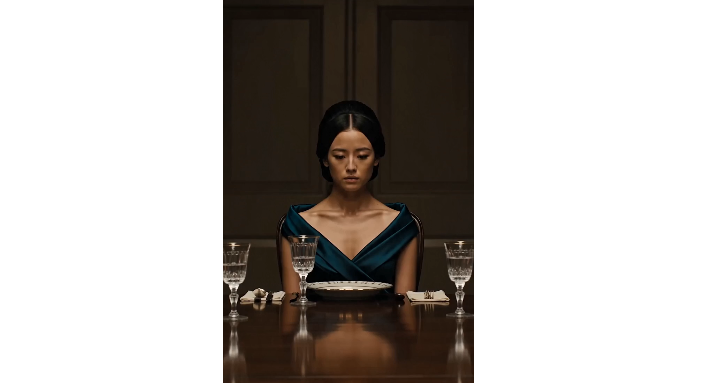
The dinner had started like so many others.
A long table was set with warm food, polished glasses, folded napkins, and the familiar tension that always seemed to live under the surface whenever Natalia sat down with her husband’s family. The room looked peaceful enough from the outside. Plates passed from hand to hand. Forks touched china. Relatives exchanged small talk. But Natalia had already learned that in this family, silence was often just a pause before criticism.
She sat beside her husband, Daniel, wearing a simple elegant dress she had chosen that afternoon after finishing a long day at work.
It wasn’t revealing.
It wasn’t flashy.
It was simply tasteful, fitted well, and made her feel confident.
That alone, with Daniel’s mother, was often enough to cause trouble.
Across the table sat Margaret, Daniel’s mother.
Perfect posture.
Perfect hair.
A woman who spoke with the certainty of someone who believed that age gave her permanent authority over everyone else’s choices.
She looked Natalia up and down once.
Then again.
Finally, she set down her fork, turned slightly so everyone could hear her, and said loudly:
“A married woman should dress more modestly.”
The sentence landed in the middle of dinner like a glass dropped on the floor.
Several relatives immediately looked up.
Then, almost like a reflex, the agreement began.
“She’s right.”
“It’s a family dinner, after all.”
“Some things are better left for going out.”
An aunt nodded with a knowing smile.
A cousin smirked into his plate.
Another woman at the table murmured, “Respect matters.”
Natalia felt every eye turn toward her.
Beside her, Daniel lowered his gaze and pretended to focus on cutting his food.
He said nothing.
He didn’t defend her.
He didn’t even look at her.
For a few seconds, Natalia stayed completely silent.
She looked at the table.
At her plate.
At the hand holding her fork.
At the man beside her, who had promised her, more than once, that things would get better.
Then she slowly lifted her eyes.
Her voice was calm.
Steady.
Not loud.
“Maybe it’s time you stop telling me what to wear.”
The whole table went quiet.
It was not the kind of quiet people choose.
It was the kind that falls when no one expects the target of humiliation to answer back.
Margaret blinked.
Daniel finally looked up.
Natalia continued, still calm:
“I work for my own clothes. And I pay for them myself.”
Margaret’s face changed.
The color shifted immediately.
Not only because Natalia had answered.
But because everyone at the table knew something she never wanted mentioned out loud.
Natalia had the most stable income in the family.
Daniel had been in and out of jobs for over a year.
Margaret herself had borrowed money “temporarily” more than once.
Natalia had never thrown it in anyone’s face.
Until now.
An uncomfortable stillness spread across the room.
Even the relatives who had agreed so quickly a moment ago now looked unsure.
Margaret cleared her throat.
“Well, that’s not the point.”
Natalia looked at her.
“Then what is the point?”
Margaret hesitated.
Daniel shifted in his chair.
“Natalia,” he muttered quietly, “let’s not do this.”
She turned to him for the first time.
“Do what? Answer?”
He opened his mouth, then closed it again.
Margaret recovered enough to speak.
“The point,” she said stiffly, “is that a wife should know how to behave in her husband’s family.”
Natalia gave a faint, tired smile.
“And a husband should know when to speak when his wife is being humiliated.”
No one moved.
No one even reached for a glass.
Every person at that table turned toward Daniel.
The moment had shifted.
This was no longer just about a dress.
It was about silence.
About disrespect.
About how many times Natalia had been expected to sit there and accept it because keeping peace was always treated as her responsibility.
Daniel looked trapped.
“Mom didn’t mean it like that,” he said weakly.
Margaret frowned.
“I meant exactly what I said.”
Natalia almost laughed, but there was no joy in it.
“Yes,” she said quietly. “That’s the problem.”
An older uncle at the end of the table tried to soften the tension.
“Come on now, this is family.”
Natalia looked at him.
“I know. That’s why it hurts more.”
Those words changed something in the room.
Until then, it had all felt like criticism dressed up as tradition.
But now the truth was sitting openly at the table.
Natalia was not overreacting.
She was tired.
Tired of the comments.
Tired of being corrected.
Tired of being spoken about as if she were a child who needed approval to exist comfortably in her own skin.
Margaret folded her napkin with controlled movements.
“You’re becoming very disrespectful.”
Natalia answered without raising her voice.
“No. I’m just no longer being obedient.”
Silence again.
Daniel’s sister slowly put down her fork.
One of the cousins looked away.
Even the aunt who had agreed so quickly now seemed embarrassed.
Margaret turned to Daniel.
“Are you going to let her talk to me like this?”
Daniel looked at his mother.
Then at Natalia.
Then at the table full of relatives waiting for him to choose a side.
Natalia watched his face.
For a moment, she thought he would do what he always did—find a way to smooth it over, to excuse it, to ask her later in private why she couldn’t have just ignored it.
But this time, something different happened.
He saw that everyone was watching.
Not just his mother.
Not just Natalia.
Everyone.
And for the first time, maybe because the silence was too heavy to escape, he understood exactly how small he had made his wife feel every time he stayed quiet.
Daniel exhaled slowly.
Then he said, still looking at the table:
“She’s right.”
Margaret stared at him.
“What?”
He lifted his head.
“She’s right,” he repeated. “She paid for her dress. She can wear what she wants. And no one should be talking to her like that.”
Margaret looked as if she had been slapped by the truth.
“Daniel—”
He didn’t let her finish.
“No, Mom. Enough.”
The whole table froze again, this time for a different reason.
No one could remember the last time he had openly contradicted her.
Daniel turned to Natalia.
His voice was quieter now.
“I should have said something the moment you were insulted. I’m sorry.”
Natalia looked at him carefully.
She could see the discomfort in his face.
The shame.
The effort it took him to say it in front of everyone.
But she had also spent too long accepting apologies that changed nothing.
So she answered honestly.
“I appreciate that you said it now. But you should understand something.”
Daniel nodded slightly.
She continued:
“If you only defend me after the room turns against you, that’s not protection. That’s pressure.”
Those words hit him hard.
He lowered his eyes.
Margaret stood up halfway from her chair, furious now.
“So now I’m the villain because I care about dignity?”
Natalia looked at her with calm clarity.
“No. You’re the problem because you confuse control with dignity.”
Nobody came to Margaret’s defense this time.
Not immediately.
The balance at the table had changed.
It was subtle, but unmistakable.
People who had once nodded along now saw too clearly what had happened: a woman had been publicly shamed over a dress, and the only reason it was suddenly uncomfortable was because she had answered without fear.
Daniel’s father, who had been silent the whole evening, finally spoke.
“Margaret,” he said quietly, “it was unnecessary.”
She turned toward him in disbelief.
“You too?”
He sighed.
“It was unnecessary.”
That was all.
But it mattered.
Margaret slowly sat back down, pale and stiff.
No more comments came.
No more judgment.
No one seemed interested in the food anymore.
Natalia looked around the table and realized something strange.
For the first time in a long time, she wasn’t the one feeling small.
The silence now belonged to everyone else.
After a moment, Natalia reached for her glass and took a sip of water.
Then she stood up.
Daniel looked at her.
“Where are you going?”
She picked up her purse calmly.
“Home.”
Margaret gave a short, offended laugh.
“You’re leaving in the middle of dinner?”
Natalia looked at her one last time.
“No. I’m leaving in the middle of disrespect.”
Then she turned to Daniel.
“If you want to come with me, come because you understand what happened here. Not because you don’t want people to judge you.”
He stood up immediately.
“Natalia, wait.”
But she was already walking toward the hallway.
Not storming out.
Not crying.
Not shouting.
Walking with quiet self-respect.
Daniel followed her.
In the front hallway, away from the table but not yet outside, he caught up to her.
“I’m sorry,” he said again.
She faced him.
“I know.”
He looked shaken.
“I should have spoken sooner.”
“Yes.”
“I’ve spent too much time trying to keep peace with my family.”
Natalia held his gaze.
“At my expense.”
He nodded.
“Yes.”
There was a long pause.
Then he said, more honestly than he had all evening:
“I didn’t realize how much my silence was costing you.”
Natalia’s eyes softened, but only slightly.
“That’s because you weren’t paying the price. I was.”
He had no answer to that.
Outside, the night was quiet.
Through the dining room window, they could still see the family sitting in stunned silence around the table.
Daniel looked back once.
Then at Natalia.
“What do we do now?”
She answered simply:
“You decide whether you want a wife you respect, or a mother you never question. Because I’m not doing this for the rest of my life.”
That night, Daniel left with her.
The drive home was mostly quiet.
Not angry quiet.
Thinking quiet.
For the first time, he was forced to sit with what had happened—not just the comment, but all the smaller moments before it. Every time his mother criticized Natalia. Every time he said nothing. Every time he later told Natalia to “let it go.”
The next morning, he called his mother.
Not to smooth things over.
Not to ask her not to be upset.
To set a boundary.
He told her clearly that Natalia would not be disrespected again, not in their home, not at family dinners, not anywhere.
Margaret was offended.
Then emotional.
Then angry.
But for once, Daniel did not retreat.
And for Natalia, that mattered more than his apology at the table.
Because words in public were one thing.
Change in private was another.
Weeks later, the family gathered again for another dinner.
Margaret was polite.
Tense, but polite.
No comments were made about Natalia’s clothes.
No one told her how a married woman should act.
And when one relative started to make a joke, Daniel shut it down before it could grow.
Natalia noticed.
She didn’t smile right away.
Trust doesn’t return in one night.
But respect had finally entered the room.
And it had entered because one evening, at a crowded family table, when everyone expected her to stay quiet, Natalia lifted her eyes and calmly said:
“Maybe it’s time you stop telling me what to wear.”