The wedding estate looked like something from a magazine.
Stone paths wound through white roses and tall lanterns. Elegant guests stepped through the open gate in expensive suits and shimmering dresses while soft wind moved the ribbons tied along the garden walls. Security guards stood near the entrance with radios on their shoulders, and every detail of the afternoon had been prepared to look perfect.
Inside, musicians were waiting.
The champagne was ready.
The bridal hall was glowing with gold light.
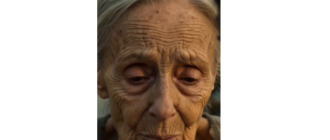
And just beyond the gate, an elderly woman in worn clothes walked slowly toward the entrance, holding a small old bag tightly in both hands.
Her shoes were faded.
Her coat was too thin for the weather.
Her face was lined with age and hardship, but her eyes were gentle and full of something deeper than fear.
Hope.
Guests noticed her immediately.
Their whispers began almost at once.
“Who is she?”
“Did she get lost?”
“Why would someone like that come here?”
The woman lowered her eyes and kept walking.
She wasn’t loud.
She wasn’t asking anyone for anything.
She was only trying to make it a few more steps inside.
Before she could go farther, the bride appeared.
Julia.
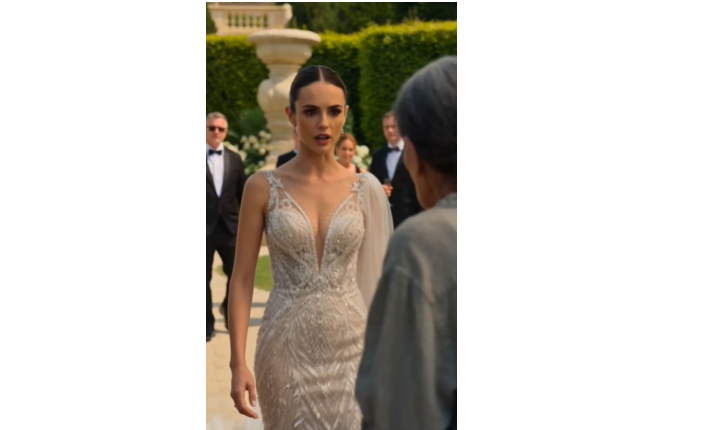
She was dressed in white, perfectly styled, surrounded by two bridesmaids and several relatives who had stepped outside for photos. The moment she saw the elderly woman, her expression changed from bright confidence to cold irritation.
Julia moved directly in front of her and blocked the path.
“You shouldn’t be here,” she said sharply.
The old woman stopped.
For a second, it seemed she might turn around and leave.
Instead, she lowered her eyes and answered in a soft, trembling whisper:
“I only wanted to see the wedding.”
Julia looked at her with disbelief.
“See the wedding?” she repeated. “This is a private event.”
A few guests nearby watched more openly now.
One bridesmaid covered her mouth, trying not to smile.
Julia folded her arms.
“You need to leave.”
The woman clutched her old bag a little tighter.
“Please,” she said quietly. “I won’t bother anyone. I just wanted to see him once.”
That sentence made a few people glance at each other.
Julia’s face hardened immediately.
She lifted her hand and signaled to security.
“Remove her,” she said coldly.
The radios crackled softly as two guards began walking toward the gate.
The elderly woman did not argue.
She only looked past Julia, toward the entrance hall, as if the distance between them and the man she had come to see was the longest distance in the world.
And then everything changed.
The groom, Mateo, had just entered the outer hall.
He was adjusting the cuff of his jacket, speaking quietly with one of his groomsmen, when he looked toward the gate.
At first, he noticed only movement.
Then he saw the elderly woman.
He stopped instantly.
The color drained from his face.
His hands began to shake.
The groomsman beside him frowned.
“Mateo?”
But Mateo wasn’t listening.
The whispers around the estate died one by one.
The whole wedding seemed to fall into silence.
Mateo stared at the woman as if he had seen a ghost.
Julia turned, confused by the sudden stillness.
“Mateo?”
He took one slow step forward.
Then another.
The security guards stopped where they were.
No one moved.
Mateo’s breathing became shallow.
When he finally reached the elderly woman, he looked straight into her eyes.
His voice came out broken, almost too quiet to hear.
“Mom…?”
A gasp moved through the guests.
Julia froze.
The old woman’s eyes filled with tears instantly.
Her lips trembled.
For a moment, she could not speak.
Then she lifted one shaking hand toward his face and whispered:
“Mateo… my boy.”
Silence spread across the estate like a wave.
No one knew what to say.
No one had expected the poor, trembling old woman at the gate to be the groom’s mother.
Julia looked from Mateo to the woman in stunned disbelief.
“That’s impossible,” she said. “You told me your mother was gone.”
Mateo did not look at her.
His eyes stayed fixed on the elderly woman.
Everyone in his life had told him his mother disappeared when he was a child.
That she left.
That she made her choice.
That she did not want the life of a wife and mother anymore.
His father had spoken about her with bitterness.
His aunt had called her unstable.
By the time Mateo was old enough to ask questions, he had been taught that his mother was part of a shameful past the family did not discuss.
And yet now she was standing in front of him.
Real.
Crying.
Aged by years of suffering.
But unmistakably real.
Mateo’s voice trembled.
“I thought you were dead.”
The woman shook her head slowly, tears falling down her face.
“No,” she whispered. “I was kept away.”
That sentence landed harder than any shout.
Julia stared.
Several guests exchanged shocked looks.
Mateo stepped even closer.
“How?” he asked. “How could you be kept away from me?”
The woman took a long breath, trying to steady herself.
“After your father became ill, his brother took control of everything. I had no money, no family name, no power. They said I wasn’t good enough for your life. They said I was ruining the family’s image.”
Mateo’s expression tightened.
His uncle.
The same man who had managed the family estate after his father died.
The same man who had always controlled the finances, the properties, and almost every major decision in Mateo’s life until recently.
The woman continued:
“When your father died, they threw me out. They took you from me. I fought at first. I went to lawyers, to offices, to anyone who would listen. But I had no proof, no money, and no one believed me. They told people I had abandoned you.”
Her voice broke.
“I wrote letters. I sent gifts on your birthdays. I came to the school once, but they threatened to have me arrested if I ever returned.”
Mateo’s face turned pale again.
He remembered birthdays with missing names.
He remembered a small toy car that arrived once with no sender and was quickly taken away by his aunt.
He remembered asking about it and being told it was nothing.
His eyes filled.
“Why today?” he asked softly.
The woman looked down at the old bag in her hands.
“Because someone from the village told me they saw your wedding in the newspaper. I knew I couldn’t come inside like a guest. I only wanted to stand far away and see you happy. Just once.”
Julia’s face had gone tense.
She was no longer angry in the same way.
Now she looked nervous.
Because the entire wedding had shifted.
The guests were no longer whispering about the poor woman at the gate.
They were looking at Julia, at the family, at the people who had been ready to throw the woman out before asking who she was.
Mateo looked at the old bag.
“What’s in there?”
The woman opened it carefully.
Inside were faded photographs, folded letters tied with a ribbon, and a tiny knitted baby cap.
She took out one photograph and handed it to him with trembling fingers.
It showed a much younger woman holding a baby wrapped in a blue blanket.
Mateo looked down.
On the back, written in careful handwriting, were the words:
My Mateo, three weeks old. My whole life.
His hands started shaking harder.
Then she gave him one of the letters.
The envelope was yellowed with age and returned stamps.
Across the front was written:
For Mateo — when he is old enough to choose the truth
Mateo could barely breathe.
He looked up at her again.
“All these years…”
She nodded through tears.
“I never stopped being your mother.”
Behind them, Julia finally spoke again, but her voice had lost its certainty.
“Mateo… we should go inside. Everyone is watching.”
He turned to her slowly.
For the first time since she had spoken at the gate, he truly looked at her.
“And what would you have done,” he asked quietly, “if I had not come out here?”
Julia hesitated.
“I didn’t know who she was.”
The woman lowered her eyes again, ashamed by the scene.
But Mateo’s face changed.
Not into anger.
Into pain.
“You didn’t ask,” he said.
Those three words made Julia fall silent.
He turned to the guests.
Many of them looked away.
Some looked ashamed.
The security guards stepped back, suddenly uncomfortable.
Mateo took his mother’s bag from her hands.
Then, in front of everyone, he offered her his arm.
“Come with me,” he said.
She stared at him in disbelief.
“Inside?”
Mateo nodded.
“You said you only wanted to see the wedding.”
Tears fell down her face again.
“Yes.”
“Then you’ll see it,” he said. “Not from the gate. Beside me.”
A murmur passed through the crowd.
Julia’s mother stepped forward at once.
“Mateo, think carefully. This is your wedding day.”
He looked at her.
“That is exactly why I am thinking carefully.”
Then he added, calmly but firmly:
“No one humiliates my mother at my wedding.”
Silence followed.
The wedding planner, who had been frozen near the doorway, stepped aside.
The path into the estate opened.
Mateo walked slowly with his mother toward the hall.
The guests parted for them.
Not because they were told to.
Because no one knew what right they had to stand in the way anymore.
Inside the grand hall, the music had stopped.
People stood from their chairs as Mateo entered not beside his groomsmen, but beside the elderly woman in worn clothes who had almost been thrown out.
He led her to the front row.
Then he turned to the guests and said:
“Before this ceremony continues, there is something everyone here needs to understand.”
The room held its breath.
“This woman is my mother. I was told all my life that she left me. Today I found out that was a lie.”
A wave of murmurs moved through the room.
Mateo raised one hand slightly, and the hall quieted again.
“She came here with nothing but old letters and photographs. Not to ruin anything. Not to ask for money. Not to beg. She came only to see me.”
He paused.
“And we were about to throw her out.”
His words hit the room with painful force.
Julia stood still at the far end of the aisle, holding her bouquet too tightly.
Mateo looked at her.
“If someone can look at an old woman at the gate and see only shame, not pain, then they are not ready to stand beside me for life.”
Julia’s eyes widened.
A bridesmaid whispered sharply.
Julia took a step forward.
“Mateo, that’s not fair.”
He answered quietly:
“No. What happened to my mother wasn’t fair.”
The room fell completely silent.
Julia’s father stood up halfway, then sat back down again when he realized this was slipping beyond control.
Mateo turned to his mother.
“Would you sit here and stay?”
She cried openly now.
“Yes.”
He kissed her forehead.
It was the first time he had touched his mother in more than twenty years.
A few guests wiped tears from their eyes.
Others looked deeply ashamed.
Then Mateo faced the officiant.
“We will not continue this ceremony today.”
A sharp breath moved through the hall.
Julia stared at him in horror.
“Are you ending the wedding?”
Mateo did not raise his voice.
“I am ending a day built on lies.”
Julia’s lips trembled.
“This is because of one scene at the gate?”
Mateo looked at her with a sadness that was somehow worse than anger.
“No. This is because I just found out who stood beside me… and who didn’t.”
Those words broke whatever illusion had been left.
Julia lowered her bouquet.
No one defended her.
No one laughed now.
The same guests who had whispered at the gate were standing in the ruins of a celebration that had collapsed in silence.
Later that afternoon, the estate emptied slowly.
Some people left embarrassed.
Some left thoughtful.
Some left with the feeling that they had witnessed something much bigger than a ruined wedding.
Mateo remained with his mother in a quiet side garden as the sun began to lower.
He asked her everything.
Where she had lived.
How she survived.
Why she had stopped coming.
She told him the truth piece by piece.
Not all at once.
Not to overwhelm him.
Just enough for him to begin seeing how much had been taken from both of them.
He learned she had worked in kitchens, laundries, and care homes.
He learned she had kept every newspaper clipping that mentioned his name.
He learned she knew the date of every birthday, every graduation, every public achievement, even though she had never been allowed near him.
And when he asked why she never gave up completely, she looked at him with tired, loving eyes and said:
“Because mothers don’t stop being mothers just because powerful people say they should.”
Mateo cried then.
Not like a groom embarrassed in public.
Not like a man protecting appearances.
Like a son.
That evening, instead of leaving for a honeymoon, he left the estate beside his mother.
And before he got into the car, he looked once more at the grand wedding gate.
The same gate where a poor old woman had almost been sent away like an inconvenience.
The same gate where he had found the person he had been missing his whole life without even knowing it.
By the following week, lawyers were reviewing the family records.
Letters were matched.
Old guardianship documents were pulled.
And one by one, the lies that had kept a mother and son apart began to collapse.
But before any court confirmed anything, before any official statement was made, before any family name was corrected, one truth had already become impossible to erase.
At the gate of a luxury wedding estate, a woman in worn clothes had come just to see her son from a distance.
And instead, she got to hear him say the word she had waited years to hear again.
“Mom.”