The rooftop party looked like something out of a magazine.
The skyline shimmered behind glass railings, candles flickered in the wind, and elegant guests moved between white floral arrangements and silver trays of champagne under the night sky.
Everything was polished.
Everything was expensive.
Everything was designed to impress.
At the center of the terrace sat Adrian Vale, silent in a wheelchair, holding a bouquet of white roses in one hand. His dark coat was perfectly cut, but his expression was unreadable—too still, too controlled.
A few guests whispered as they watched him.
Everyone knew why the party mattered.
Everyone knew it had been organized to celebrate the merger between two powerful families—and the engagement that was supposed to seal it.
Across from him stood Vanessa.
Beautiful, elegant, and dressed like someone who had never had to wonder what security looked like. She stared at Adrian with a strange mix of anger and superiority, as if she had already decided what the entire evening would become.
Then, in front of everyone, she stepped forward and snatched the white roses from his hands.
A few petals fell instantly.
Gasps rippled through the rooftop.
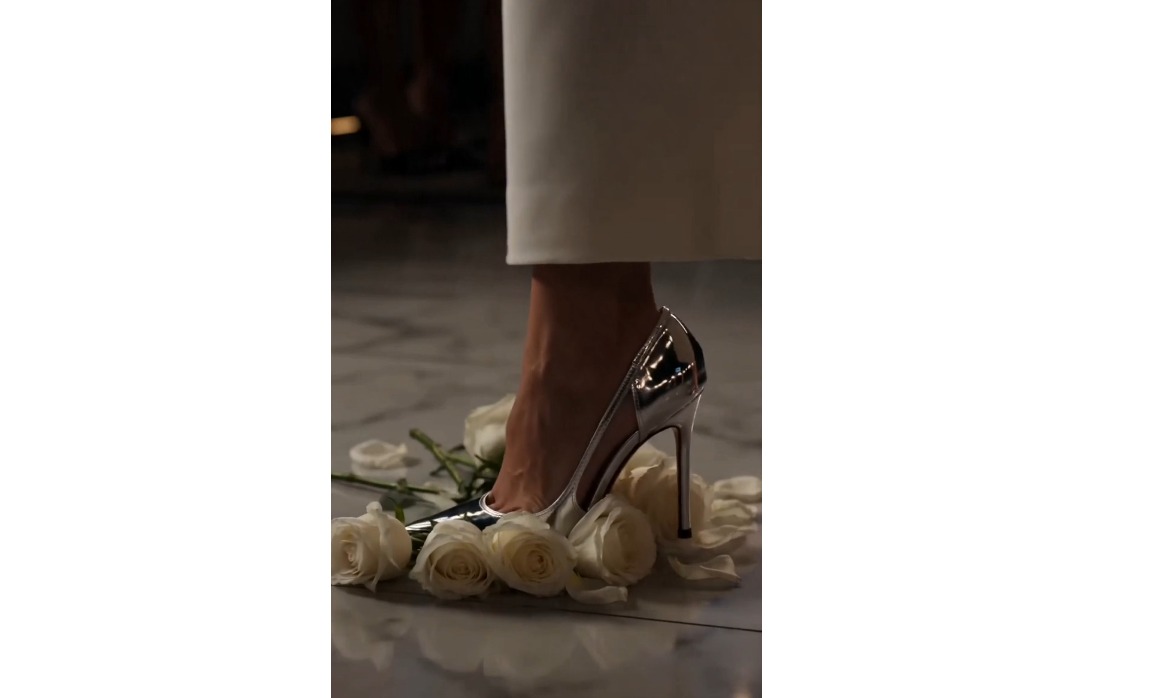
Vanessa looked down at him with cold finality and dropped the bouquet to the floor.
Then she crushed the roses beneath the heel of her shoe.
“Everything between us is over.”
The rooftop fell into stunned silence.
No one moved.
No one dared interrupt.
Vanessa turned away, lifting her chin as if the moment belonged to her.
Around them, guests looked at Adrian with pity.
Some lowered their eyes.
Some exchanged uncomfortable glances.
A few seemed almost relieved that the public humiliation was over.
But then something happened that no one was prepared for.
A chair shifted slightly.
A hand gripped the armrest.
And Adrian stood up.
The rooftop went completely silent.
Vanessa froze before she had fully turned.
One guest almost dropped his glass.
Another took an involuntary step back.
Adrian rose slowly, steadily, with no sign of struggle in his face—only a calm, almost frightening control. He stepped away from the wheelchair and shrugged off his coat, revealing an impeccably tailored suit beneath it.
The wind moved lightly through his shirt collar.
No one breathed.
Vanessa stared at him as if the world had tilted beneath her feet.
“Adrian…” she whispered.
But he didn’t answer.
He bent down slowly toward the ruined bouquet.
Among the crushed white petals and broken stems, something flashed beneath the rooftop lights.
A diamond ring.
He picked it up carefully.
For a moment he simply looked at it in his hand, then raised his eyes to Vanessa.
His expression had changed.
The sadness she had expected to see was gone.
What remained was colder than anger.
“Did you really think I had nothing left to lose?”
Vanessa’s face lost color.
The guests were no longer looking at Adrian with pity.
Now they were looking at Vanessa with something closer to fear.
Because all at once, pieces of a much larger truth began to settle into place.
Adrian had not been helpless.
He had not been broken.
And he had definitely not been dependent.
Vanessa took one slow step toward him, her voice trembling.
“You lied to me…”
Adrian gave the faintest, bitter smile.
“No,” he said. “I stayed silent.”
The distinction hit harder than if he had shouted.
At the edge of the rooftop, Vanessa’s father, Martin Hale, stiffened visibly.
He had spent months pushing this engagement.
Months praising Adrian in public while privately assuring his daughter that if anything ever went wrong, she would always “have the stronger position.”
Now, for the first time that night, Martin looked deeply uncertain.
Adrian noticed.
Of course he did.
He turned slightly, just enough to let his gaze sweep across the guests.
“You all looked at me the same way,” he said quietly. “Like I was a man to be tolerated… managed… pitied.”
No one answered.
He looked back at Vanessa.
“But you,” he continued, “were supposed to know the difference between weakness and restraint.”
Vanessa’s throat tightened.
“Why would you do this?” she asked. “Why pretend?”
Adrian glanced once at the wheelchair.
Then at the people gathered around them.
And finally back at her.
“Because when you tell people the truth too early,” he said, “they hide who they are.”
The words seemed to pass through the crowd like a cold current.
Vanessa’s eyes widened.
This had not been a misunderstanding.
This had been a test.
And she had failed it in front of everyone.
One of the older investors standing near the bar stepped forward slightly, his face tense with realization.
He cleared his throat and said in a low voice to another guest:
“She doesn’t know, does she?”
Vanessa turned sharply.
“Know what?”
No one answered immediately.
That silence was worse than any direct response.
Then Adrian spoke.
“Your family’s luxury life,” he said evenly, “the Hale towers, the redevelopment deal, the liquidity that saved your father’s company six months ago…”
He let the words hang in the air.
“…all of it depends on my signature next week.”
Vanessa stared at him.
The breath left her body in a stunned, silent rush.
Her father stepped forward quickly.
“Adrian, let’s not do this here.”
Adrian turned his head toward him, still holding the ring.
“No?” he asked. “Where should we do it, Martin? In a boardroom? Behind closed doors? After your daughter publicly crushed the proposal she begged you to secure?”
The rooftop seemed to shrink around them.
Vanessa looked at her father.
“Begged you to secure?”
Martin’s face hardened with panic.
“Vanessa—”
But she was no longer listening to him.
She was staring at Adrian now with the horror of someone realizing she had misunderstood every power in the room.
Adrian had never been the vulnerable one.
He had been the one allowing everyone else to reveal themselves.
The wheelchair—once the symbol of what she believed made him weak—now stood behind him like the final piece of a deliberate mask.
He looked at it once, then back at her.
“There was a time,” he said quietly, “when that chair was real.”
For the first time, his voice held something human beneath the ice.
“After the accident, I learned very quickly who stayed because they cared… and who stayed because they thought I would remain easy to control.”
Vanessa’s eyes filled, but whether with guilt, fear, or humiliation, even she no longer seemed to know.
“I didn’t know,” she whispered.
Adrian answered without hesitation.
“You didn’t want to know.”
The diamond ring shone in his hand between them.
Once, it had been an offer.
Now it looked like evidence.
Evidence of the exact moment someone mistook dignity for helplessness.
A gust of wind sent crushed petals sliding across the rooftop floor.
The symbolism was almost unbearable.
Vanessa moved again, more carefully this time.
“Adrian… please. Let me explain.”
But his face remained unreadable.
“You already did,” he said.
He looked down at the crushed roses.
Then at the ring.
Then at the guests, many of whom had smiled politely while she humiliated him.
“One thing I’ve learned,” he said, “is that people are most honest when they think the person in front of them has no power to answer back.”
No one could meet his eyes.
Not Vanessa.
Not Martin.
Not the guests.
A woman near the edge of the terrace quietly set down her champagne glass, unable to keep pretending she was witnessing a simple social conflict.
This was not about romance anymore.
It was about character.
About greed.
About cruelty exposed under perfect rooftop lights.
Martin tried one final time.
“Adrian, whatever decision you make—”
Adrian cut him off.
“The decision is already made.”
He slipped the ring back into its box.
Then he placed the closed box gently on the table beside the wheelchair.
The gesture was small, but final.
Vanessa’s voice cracked.
“You can’t do this.”
Adrian’s eyes hardened.
“I can,” he said. “And tonight, you made sure I should.”
Those words ended everything.
Not just the proposal.
Not just the alliance.
Something deeper had broken.
The illusion that Vanessa could humiliate a man she considered damaged and still walk away untouched.
The illusion that Martin Hale could build his future by treating Adrian as a formality.
The illusion that silence meant weakness.
Adrian picked up his coat, draped it over one arm, and turned to leave.
As he passed the wheelchair, one guest instinctively stepped aside, as if the empty chair itself had become a witness no one wanted to stand too close to.
Vanessa remained frozen where she stood.
Her father’s face looked gray.
The guests were silent, but not with confusion anymore.
With understanding.
Because now they all saw what she had only just begun to understand:
the life she had flaunted—the parties, the image, the luxury, the certainty—had not been hers by right.
It had been balanced on a man she thought she could dismiss.
And in one brutal moment, she had shown him exactly why he should let it all fall.
By the next week, the engagement was over.
So was the merger.
Adrian withdrew his support from the Hale deal, and the story that spread through private circles was not the official one.
Officially, it was called a strategic reconsideration.
Unofficially, everyone knew the truth.
At a rooftop party, a woman had crushed a bouquet of white roses under her heel, not realizing that hidden among them was the ring—and that the man she humiliated held the future of her entire world.
Months later, people still talked about the silence that followed when Adrian stood up from the wheelchair.
Not because it was dramatic.
But because in that instant, every false assumption in the room collapsed at once.
And Vanessa, standing among the broken petals, finally understood that she had not been ending a relationship.
She had been destroying the one person who had quietly been holding up the life she thought was already hers.