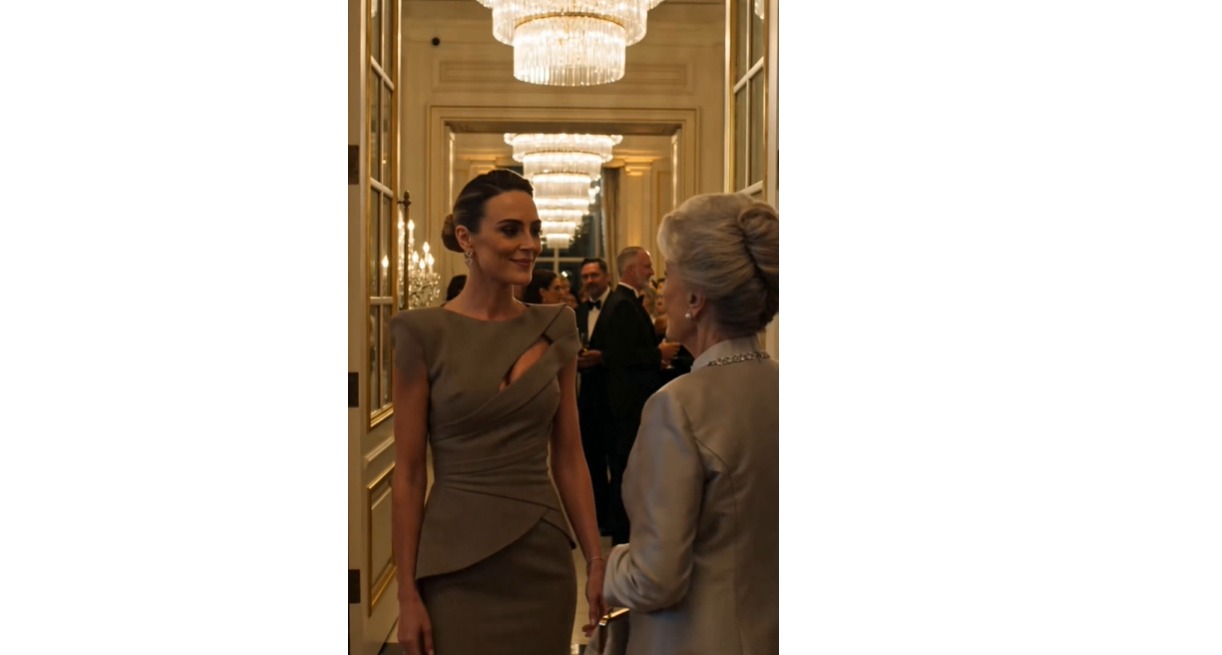
The grand ballroom of the Harrington Group headquarters had been transformed for the company’s fiftieth anniversary.
Crystal glasses shone beneath warm lights, executives greeted important guests, and a large screen displayed the company logo above the stage.
Victoria Harrington moved confidently through the crowd. As the wife of the company’s current president, she had spent weeks overseeing every detail of the celebration.
She wanted the evening to appear flawless.
Near the entrance, however, she suddenly noticed an elderly woman wearing a simple dark coat and carrying an old leather handbag.
It was Eleanor Harrington, her mother-in-law.
Eleanor had refused the expensive dress Victoria had sent to her. She preferred the clothes she had owned for years and had arrived without jewelry, a driver, or any visible sign of wealth.
Victoria hurried toward her before the other guests could approach.
“Your outfit does not belong at this event,” she said coldly.
Several nearby guests heard the remark and exchanged uncomfortable smiles.
Victoria took Eleanor gently but firmly by the arm.
“There is a quieter area beside the hall. You will be more comfortable there.”
Eleanor understood exactly what she meant.
Victoria did not want her seen.
The elderly woman said nothing. She only held her old handbag more tightly as Victoria guided her away from the main entrance.
Before they reached the side room, the lights dimmed.
A voice announced the beginning of the company’s anniversary presentation.
Guests turned toward the large screen as old photographs appeared one after another.
The first rented office.
The original delivery truck.
The small team that had worked through the company’s difficult early years.
Then a faded photograph filled the screen.
A young Eleanor stood beside a modest brick building, holding the same leather handbag she carried that evening.
Victoria stopped walking.
Her smile disappeared.
The narrator’s voice echoed across the ballroom.
“Our company began with Eleanor Harrington’s first investment.”
The guests became silent.
Another image appeared, showing Eleanor signing the original business agreement beside her late husband, Thomas.
The presentation explained that Thomas had possessed the idea, but no bank had been willing to finance him.
Eleanor had sold a small property inherited from her parents and invested every penny in the business. During the first years, she had managed the accounts, negotiated with suppliers, and worked without a salary to keep the company alive.
The old handbag had carried the first contracts, payroll envelopes, and handwritten orders.
Victoria slowly released Eleanor’s arm.
People who had smiled moments earlier now looked at the elderly woman with astonishment.
Her son, Richard, the current president of the company, stepped onto the stage.
He had not witnessed Victoria’s remark, but from the expression on his mother’s face, he sensed that something had happened.
He walked toward her and offered his hand.
“Mother, would you join me?”
Eleanor hesitated before following him onto the stage.
The guests rose and applauded.
Richard waited until the room became quiet.
“Tonight, we are celebrating fifty years of success,” he said. “But this company would not exist without the courage of one person.”
He turned toward Eleanor.
“My father gave the company its name. My mother gave it its first chance.”
Eleanor opened her old handbag and removed a folded receipt protected inside a clear sleeve.
It was the document showing the sale of her inherited property and the first deposit into the company’s account.
“I kept this,” she said softly, “not because of the money, but because it reminds me how uncertain everything once was.”
She looked around the ballroom.
“We did not begin with luxury. We began with trust, sacrifice, and people willing to work when success was not guaranteed.”
Her words were met with another long round of applause.
Victoria remained at the edge of the stage, pale and silent.
After the presentation, she approached Eleanor privately.
“I am ashamed of what I said,” she admitted. “I judged you by your clothes because I wanted everything tonight to look impressive.”
Eleanor studied her calmly.
“The problem was not that you disliked my coat,” she replied. “The problem was that you believed someone’s value could be hidden by it.”
Victoria lowered her eyes.
She apologized again, this time without excuses.
Later that evening, Richard learned what had happened near the entrance. He was deeply disappointed, but Eleanor asked him not to turn the mistake into a public humiliation.
“She has already been shown the truth,” Eleanor said. “Now we will see whether she learns from it.”
In the months that followed, Victoria changed the way company events were organized. She created an annual ceremony honoring retired employees, early investors, assistants, drivers, and factory workers whose contributions had been forgotten over time.
At the first ceremony, Eleanor sat in the front row wearing the same simple coat.
No one tried to move her away from the main hall.
Her old handbag was later placed in the company archive beside the original documents, not as a symbol of poverty, but as proof that great institutions often begin with quiet sacrifices no celebration should ever forget.