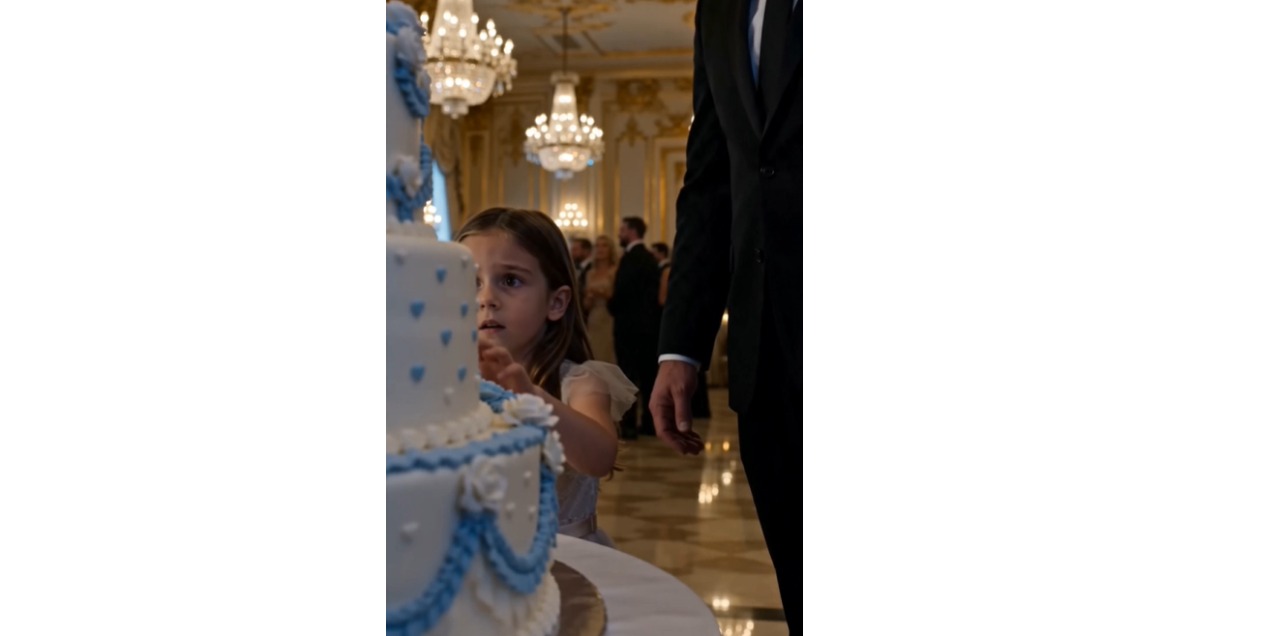
The banquet hall glittered with crystal lights, golden decorations and hundreds of white flowers.
At the center of the room stood an enormous birthday cake.
It was surrounded by wrapped gifts, candles and a large LED screen displaying photographs of the wealthy Harrison family.
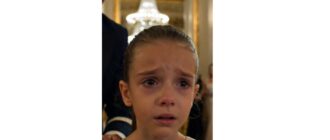
Near the stage stood a little girl named Mia.
She wore a simple cream-colored dress and held an old invitation with both hands.
For several minutes, she watched the cake from a distance.
Then she slowly stepped closer.
Before she could reach the table, a security worker approached her.
“I’m sorry, sweetheart. You can’t stand here.”
Mia looked up at him.
“I only wanted to see the cake.”
The worker gently guided her away from the stage.
She turned her head back toward the candles and whispered:
“It’s my birthday too.”
Several guests heard her.
They began whispering among themselves.
But no one intervened.
At the front table sat the wealthy hostess, Caroline Harrison.
She watched the scene with a cold expression.
Earlier that evening, Caroline had noticed Mia near the entrance.
The little girl’s name was not printed on the elegant guest list Caroline had approved.
Her dress was simple, and she had arrived without an adult.
Caroline immediately assumed she had entered the banquet by mistake.
She leaned toward one of the staff members.
“Please make sure she doesn’t appear in the family photographs.”
The security worker continued leading Mia toward the side exit.
Suddenly, the large screen behind the cake flickered.
The cheerful party photographs vanished.
The hall became quiet.
A recorded video appeared.
An older man stood in front of the same banquet hall several months earlier.
He was Michael Grant, the founder of the charity that had paid for the celebration.
Behind him appeared an old photograph of Mia smiling beside her mother.
Caroline slowly stood from her chair.
Her face lost its color.
Michael’s recorded voice filled the room.
“If you are watching this message, then tonight’s celebration has officially begun.”
The screen changed again.
A legal document appeared, covered with signatures and a gold seal.
Guests leaned forward to read it.
Michael continued:
“This celebration was prepared in Mia Grant’s name.”
The entire room became silent.
Mia stopped walking.
The security worker immediately released her hand.
Caroline stared at the screen in disbelief.
“That can’t be correct,” she whispered.
The event manager stepped onto the stage holding a sealed folder.
“It is correct.”
He explained that Michael Grant had organized the banquet before his death.
Mia was his only granddaughter.
Her mother had spent years working with his foundation, helping children who could not afford birthday celebrations of their own.
Before passing away after a long illness, she had asked Michael to make one promise.
She wanted Mia’s next birthday to be filled with warmth, family and people who understood that no child should feel invisible.
Michael rented the hall, paid for the cake and invited supporters of the foundation.
The Harrison family had been asked to host the evening because Caroline had publicly presented herself as a close supporter of children’s charities.
But the banquet had never been intended as a private celebration for Caroline’s family.
It had been arranged for Mia.
Caroline looked at the decorations.
The initials printed on the cake were not those of her own daughter, as she had assumed.
They were Mia Grant’s.
The event manager opened the sealed folder.
Inside was a handwritten letter from Michael.
He read it aloud.
“My dear Mia,
Your mother believed that birthdays were not important because of gifts or expensive rooms.
They were important because they reminded a child that her life mattered.
This evening belongs to you.
Never allow anyone to convince you that you are standing in a place where you do not belong.”
Mia’s eyes filled with tears.
Caroline lowered her head.
She had changed several details of the event without carefully reading the original agreement.
She had placed photographs of her own family on the screen.
She had moved the guest of honor’s reserved chair away from the main table.
And she had instructed the staff to remove anyone she did not recognize.
The guests slowly turned toward her.
One elderly woman asked quietly:
“Did you know who the child was?”
Caroline struggled to answer.
“No.”
The event manager looked at her.
“You were given the full documents two weeks ago.”
Caroline remembered the folder.
She had handed it to an assistant without opening it.
She had been more concerned about the flowers, photographers and social guests than the reason for the celebration.
Mia remained near the edge of the stage.
The security worker knelt beside her.
“I’m very sorry.”
Mia nodded gently.
“I know you were only doing what you were told.”
The kindness in her answer made Caroline feel even more ashamed.
She slowly walked toward the child.
“Mia…”
The girl looked at her.
Caroline took a breath.
“I judged you without asking your name.”
She glanced toward the cake.
“And I treated your celebration as though it belonged to me.”
Her voice trembled.
“I am sorry.”
Mia did not respond immediately.
Then she asked:
“Can everyone stay?”
Caroline looked surprised.
“After what happened?”
Mia nodded.
“My mother said no one should feel left out at a birthday party.”
The hall became silent again.
This time, the silence was filled with respect.
The event manager led Mia back toward the stage.
The guests moved aside and created a path for her.
When she reached the cake, the screen changed one final time.
A photograph of Mia and her mother appeared beneath the words:
Tonight We Celebrate a Life That Matters
The candles were lit.
Everyone began singing softly without music.
Mia closed her eyes and made a wish.
Then she cut the first slice of cake.
Instead of keeping it for herself, she handed it to the security worker who had apologized to her.
The second slice went to Caroline.
“Why are you giving this to me?” Caroline asked.
Mia smiled faintly.
“Because you should remember this birthday too.”
Caroline accepted the plate with trembling hands.
After that evening, she resigned from her public role in the charity and later returned as a volunteer.
She spent months learning the names and stories of the children the foundation supported.
The banquet hall also introduced a new rule.
No guest, especially a child, could ever be removed without first checking the complete event records.
Years later, Mia became the director of her grandfather’s foundation.
Every year, she organized a large shared birthday celebration for children who had never had one.
At the entrance, a sign carried the same words from her grandfather’s letter:
You Are Never Standing Where You Do Not Belong
Mia never forgot the night she was led away from her own cake.
But she also never forgot what happened afterward.
The room had been filled with wealthy and influential people.
Yet the most powerful person there had been a quiet little girl who, even after being excluded, still asked that everyone be allowed to stay.